


Quick Answer:
Yes — honeycomb blinds are widely considered the most energy-efficient internal window furnishing available. Their cellular structure traps pockets of dead air between the window and the room, creating a thermal barrier that reduces heat transfer, improves insulation, lowers energy bills, and helps Melbourne homes stay cooler in summer and warmer in winter.
Why Melbourne Homes Lose So Much Heat Through Windows
Melbourne homes face a unique challenge.
One week it’s 38 degrees and dry. The next, you’re reaching for the heater and dealing with icy overnight temperatures. That constant fluctuation places enormous pressure on your home’s thermal performance.
And most people don’t realise where the biggest problem sits.
Your windows.
Even in well-built homes, windows are typically the weakest thermal point in the building envelope. According to energy efficiency studies, up to 30% of heating and cooling energy can be lost through uncovered or poorly covered windows.
That means:
- Split systems work harder
- Heating escapes faster
- Rooms become inconsistent in temperature
- Energy bills climb every season
This is why more Melbourne homeowners are now researching the best blinds for insulation Melbourne properties can realistically benefit from — not just for aesthetics or privacy, but for measurable energy performance.
And this is exactly where honeycomb blinds stand apart.
Unlike standard roller blinds or aluminium venetians, honeycomb blinds are engineered specifically to reduce heat transfer.
Not as a side benefit.
As their primary purpose.
The Science Behind the Cellular Design

Honeycomb blinds are also known as cellular blinds, and that name matters because it explains exactly how they work.
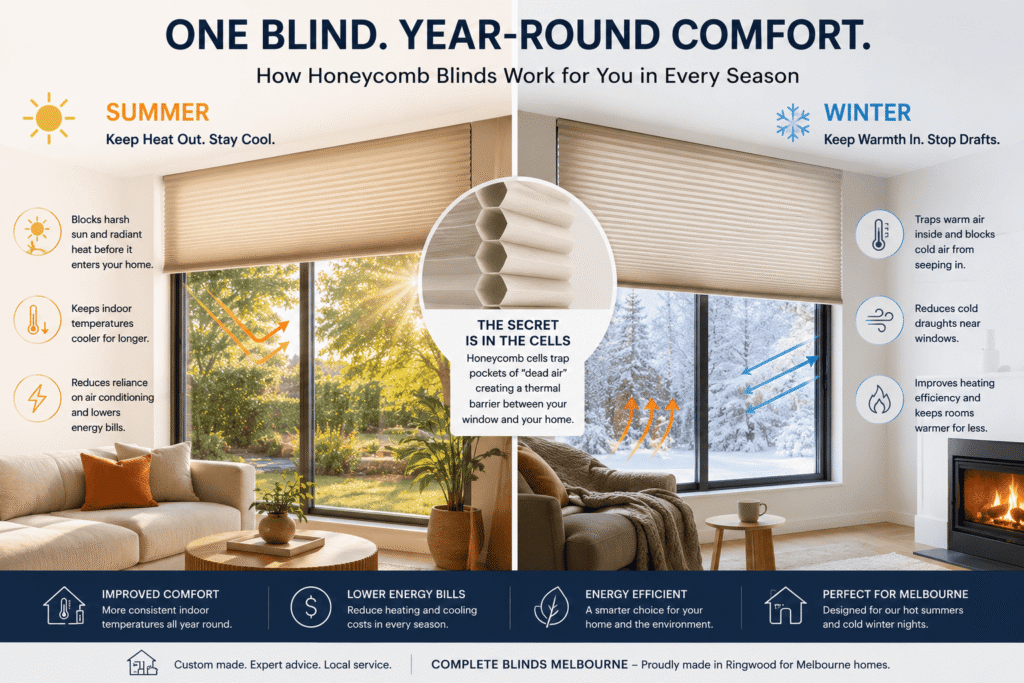
If you cut one open from the side, you’ll see a series of connected air pockets that resemble a honeycomb structure. These cells form insulated chambers between the glass and the room.
That trapped air is the key.
Air itself is a poor conductor of heat. When it becomes trapped and unable to circulate freely — often referred to as “dead air” — it acts as insulation.
This same principle is used in:
- Double glazing
- Insulated wall cavities
- Thermal clothing
Honeycomb blinds simply apply that same thermal logic to your windows.
Why the Shape Matters
The hexagonal cell structure isn’t just aesthetic.
It maximises:
- Air retention
- Structural stability
- Thermal resistance
Instead of allowing heat to pass directly through the blind material, the cellular chambers interrupt the transfer process.
This creates a thermal barrier between:
- Hot external glass and your room during summer
- Cold window surfaces and your warm indoor air during winter
The result is a more stable internal temperature and less reliance on artificial heating and cooling.
That’s why thermal honeycomb blinds consistently outperform traditional blind systems in insulation testing.
Why Standard Blinds Struggle With Insulation
Many homeowners assume all blinds help with insulation equally.
They don’t.
A standard roller blind primarily blocks light and glare. It sits relatively flat against the window, offering minimal thermal resistance.
Aluminium venetians are even less effective because metal conducts heat rapidly.
Honeycomb blinds are different because they actively trap air.
Here’s a simplified comparison:
Standard Roller Blinds
- Good for privacy
- Moderate light control
- Limited insulation performance
Aluminium Venetians
- Durable
- Easy to clean
- Poor thermal efficiency due to conductive material
Honeycomb Blinds
- Excellent thermal insulation
- Strong energy efficiency performance
- Effective year-round comfort control
This is why homeowners researching cellular blinds energy efficiency often end up moving away from standard blind systems entirely.
Understanding R-Values: The Real Measure of Insulation
If you’re serious about insulation, you need to understand R-values.
An R-value measures thermal resistance — essentially, how effectively a material slows heat transfer.
The higher the R-value, the better the insulation.
Most people associate R-values with:
- Ceiling insulation
- Wall batts
- Double glazing
But window furnishings also have measurable thermal performance.
And this is where honeycomb blinds become technically impressive.
How Honeycomb Blinds Improve R-Values
Bare glass performs poorly thermally.
Even modern windows allow substantial heat transfer. Honeycomb blinds improve this by adding insulating layers between the room and the glass.
Depending on the fabric type and cell structure, honeycomb blinds can significantly improve the effective R-value of a window system.
Double-cell honeycomb blinds perform even better because they create multiple insulating chambers.
This means:
- Less heat entering during summer
- Less warmth escaping during winter
- More stable room temperatures throughout the day
Compared to standard window furnishings:
- Roller blinds offer minimal R-value improvement
- Venetians provide little thermal resistance
- Honeycomb blinds deliver one of the highest insulation performances available internally
For Melbourne homes dealing with unpredictable seasonal swings, that difference becomes noticeable very quickly.
Why We Recommend Norman Honeycomb Blinds
Not all honeycomb blinds are equal.
There’s a major difference between premium cellular systems and cheap off-the-shelf products.
This is why we strongly recommend Norman Honeycomb Blinds for homeowners wanting genuine long-term performance.
Norman has built a reputation globally for engineering quality window furnishings that combine aesthetics with measurable thermal efficiency.
And in practice, the difference is obvious.
What Sets Norman Apart
Superior Fabric Stability
Cheap cellular blinds often lose their shape over time.
Pleats begin to sag. Cells collapse unevenly. The blind starts looking tired within a few seasons.
Norman systems are designed to retain crisp pleat structure long term, which is critical because the cellular chambers must maintain their shape to preserve insulation performance.
Better Energy Efficiency
Premium fabrics and tighter construction improve thermal resistance.
This means the insulating air pockets perform more effectively over time instead of degrading due to poor materials or loose fabrication.
Cleaner Operation
High-quality internal mechanisms ensure:
- Smoother lifting
- Better alignment
- Reduced wear on cords and systems
That matters in larger Melbourne homes where blinds are used constantly throughout the day.
Better Light Control
Norman systems also offer:
- Light filtering fabrics
- Room darkening options
- Blockout configurations
This allows homeowners to customise comfort room by room.
How Honeycomb Blinds Work in Melbourne Summers
Melbourne summer heat behaves differently from dry inland climates.
You’re not just dealing with ambient air temperature — you’re dealing with radiant heat transfer through glass.
When sunlight hits a window:
- Glass heats rapidly
- Heat radiates into the room
- Internal temperatures spike quickly
Honeycomb blinds slow this process dramatically.
Their cellular structure reduces radiant heat transfer before it enters the living space.
That means:
- Rooms stay cooler longer
- Split systems cycle less frequently
- Afternoon sun becomes more manageable
This is particularly important in west-facing rooms, which often become unusable during peak summer heat.
Homeowners asking do honeycomb blinds keep heat out are usually surprised by how noticeable the difference is once installed properly.
Winter Performance: The Other Half of the Equation
Winter is where honeycomb blinds truly prove their value.
Cold glass creates downdraughts inside the home. Even with heating running, rooms near windows often feel colder because warm air cools rapidly against the glass surface.
Honeycomb blinds interrupt that process.
The trapped air inside the cells acts as insulation, reducing heat loss and minimising cold air movement near windows.
This helps:
- Retain furnace and ducted heating warmth
- Reduce cold spots near windows
- Improve comfort during overnight temperatures
Melbourne winters may not reach sub-zero extremes regularly, but they’re long enough for poor insulation to become expensive.
And unlike external shading systems, honeycomb blinds work year-round.
The Financial ROI of Honeycomb Blinds
A lot of homeowners focus only on the upfront cost of blinds.
That’s understandable.
But honeycomb blinds should really be viewed differently.
They are an energy-efficiency upgrade.
Just like:
- Ceiling insulation
- Double glazing
- Solar systems
They actively reduce the workload on your heating and cooling systems.
Over time, that means:
- Lower electricity usage
- Reduced gas heating demand
- Less strain on split systems
- Improved seasonal comfort
In larger homes, the savings can become significant over multiple years.
But the return isn’t only financial.
There’s also lifestyle ROI:
- Better sleep in temperature-controlled rooms
- More comfortable living areas
- Reduced glare on screens and flooring
- Less dependence on constant thermostat adjustments
That daily comfort difference matters more than most people expect.
Why Local Expertise Matters
Honeycomb blinds perform best when measured and installed correctly.
Even small gaps around the edges can reduce thermal efficiency significantly.
That’s why working with experienced local specialists matters.
At Complete Blinds, we manufacture and supply premium custom blinds in Melbourne directly from our Ringwood showroom and factory.
That gives Melbourne homeowners:
- Accurate measuring
- Proper fitment
- Expert advice based on orientation and room usage
- Custom solutions instead of generic sizing
And because we understand Melbourne’s climate specifically, recommendations are made with real-world seasonal performance in mind — not just showroom appearance.
Frequently Asked Questions About Honeycomb Blinds
Yes. The cellular air pockets help absorb sound and reduce echo, making rooms feel quieter and more insulated acoustically.
They can. Blockout honeycomb blinds are designed specifically for bedrooms and media rooms where maximum darkness is required.
Most can be cleaned using:
* A vacuum with brush attachment
* Compressed air
* Light spot cleaning with a damp cloth
Professional cleaning is recommended for heavily soiled blinds.
Yes. Roller blinds mainly provide privacy and light control, while honeycomb blinds are engineered specifically for thermal insulation.
They can help reduce condensation by limiting temperature differences between the room air and the window surface.
For Melbourne homes dealing with extreme heat or cold, absolutely. Double-cell designs provide even greater thermal resistance and energy efficiency.
So, Are Honeycomb Blinds Really the Best for Insulation?
For internal window furnishings, the answer is yes.
Their cellular structure is specifically engineered to trap insulating air, reduce heat transfer, and improve year-round comfort. No other internal blind system combines thermal efficiency, comfort, and visual simplicity quite as effectively.
And in Melbourne’s unpredictable climate, that performance difference becomes impossible to ignore.
For homeowners wanting lower energy bills, reduced draughts, and more stable indoor temperatures, honeycomb blinds are not just a style upgrade.
They’re a practical investment in how your home performs every single day.


