


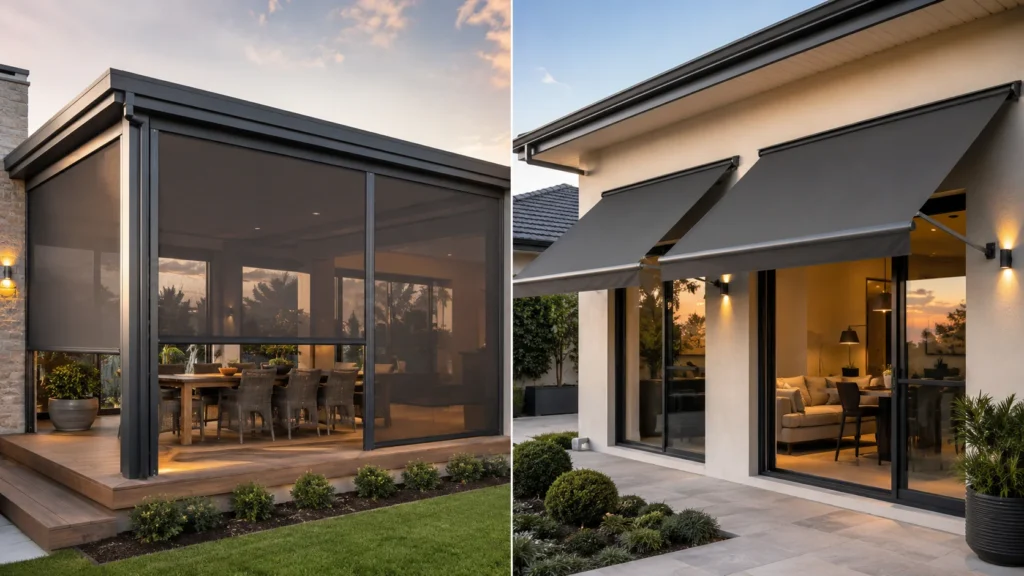
Quick Verdict: Outdoor blinds are best when you want to create a sealed alfresco room that blocks wind, insects, glare, and sideways rain. Awnings are best when you need flexible overhead or window shading that stops solar heat before it hits the glass. For Melbourne homes, the right choice depends on structure, exposure, orientation, and how you use the space.
Outdoor Blinds vs Awnings: Why This Decision Matters in Melbourne
Melbourne outdoor living is not gentle on fabric systems.
A patio can feel perfect at 11 am, then become wind-blasted by 3 pm. A balcony can overheat through north-facing glass in January, then feel damp and exposed during a sudden southerly change. Builders, renovators, and homeowners know the problem well: a beautiful alfresco area is only valuable if it can actually be used.
That is why the comparison between outdoor blinds vs awnings needs to go deeper than appearance.
This is an engineering decision.
Outdoor blinds and awnings both protect outdoor and indoor spaces, but they solve different problems. Outdoor blinds are vertical enclosure systems. They are designed to close off alfresco zones, protect from side wind, reduce glare, block insects, and improve privacy. Awnings are shading systems. They are designed to stop sun before it reaches windows, walls, decks, and glass doors.
Both can be excellent.
The wrong choice, however, can create frustration: fabric flapping in wind, poor rain protection, sagging panels, gaps around edges, or a system that simply does not suit the structure it is fitted to.
Complete Blinds has spent more than 35 years manufacturing and fitting external shading systems for Melbourne homes. From our local factory hub in Ringwood, we custom-craft outdoor systems for real Victorian conditions — not showroom theory.
The Physics of Melbourne’s Climate
Melbourne’s climate is the reason this topic deserves proper technical thinking.
A home in Brighton, Glen Waverley, Box Hill, Ringwood, or Toorak may experience three competing forces across the same year:
- Harsh summer sun and 40°C northerly winds
- Sudden cool southerly changes with damp air
- Low winter sun that penetrates deeply through glass
The challenge is not just heat. It is movement.
Wind moves fabric. Rain tracks sideways. UV breaks down cheap materials. Heat transfers through glass quickly. Once solar radiation passes through a window, it becomes far harder to control. That is why external shading is so effective. It tackles the heat before it enters the building envelope.
Awnings are especially strong here. They shade glass and prevent solar heat absorption at the source. Outdoor blinds, especially Ziptrak outdoor blinds, solve a different but equally important problem: they help turn an exposed outdoor area into a protected living zone.
Think of it this way.
Awnings defend the building.
Outdoor blinds defend the room.
That distinction makes the decision much clearer.
Outdoor Blinds: The Alfresco Room-Maker
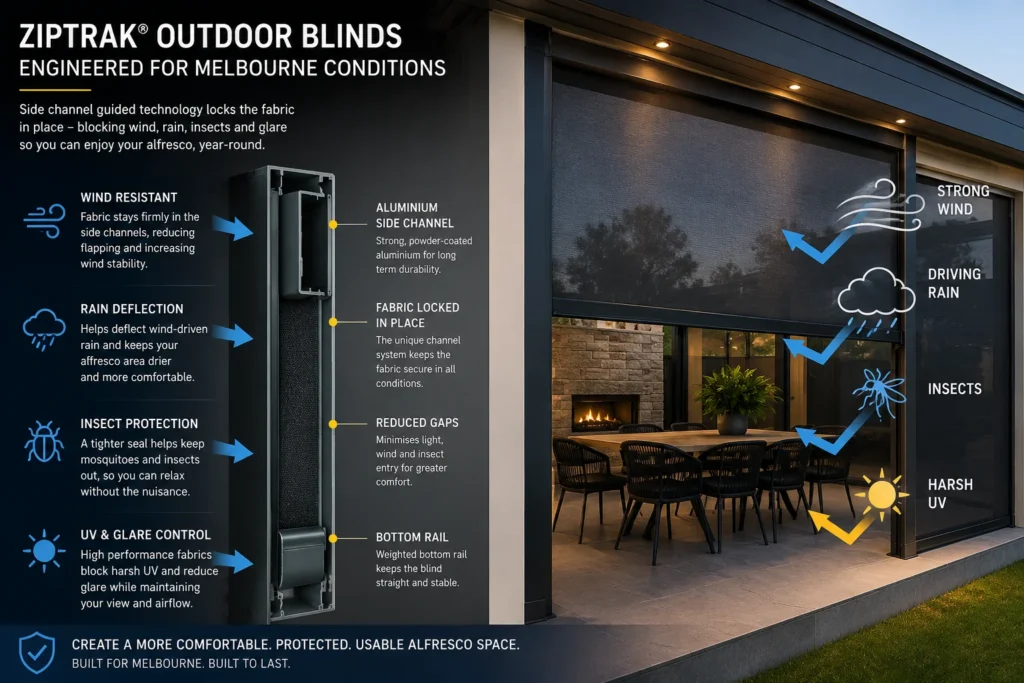
Outdoor blinds are vertical systems fitted to patios, pergolas, decks, balconies, and alfresco openings. Their job is to close the gap between posts, beams, and floor levels so an open outdoor area becomes more usable in changing weather.
High-end systems such as Ziptrak outdoor blinds have become especially popular in Melbourne because they run inside side channels rather than hanging loose. These channels guide the fabric down both sides, hold the blind under better tension, reduce gaps, and stop the fabric from flapping or twisting in changing wind conditions.
This matters.
Wind does not need a large opening to become annoying. Even a small side gap can allow draughts, dust, insects, and rain spray into an alfresco area. Track-guided Ziptrak outdoor blinds reduce that exposure by keeping the fabric secured vertically.
For modern open-plan alfresco structures in suburbs like Box Hill and Glen Waverley, this is a major advantage. Many new homes now have large rear openings connecting the kitchen, dining area, and outdoor entertaining zone. Without protection, that alfresco space can be too hot, too windy, or too exposed for much of the year.
Outdoor blinds help create a genuine outdoor room.
They can provide:
- Wind reduction across open alfresco spans
- Better privacy from neighbouring properties
- Protection from insects during evening entertaining
- Reduction of glare and UV exposure
- Improved comfort around outdoor dining areas
- More practical use of decks and patios in shoulder seasons
The best results come from proper measuring and structural assessment. A Ziptrak outdoor blind fitted to a square, well-supported opening will perform far better than a loose blind attached to weak framing or uneven posts.
That is where factory-direct production matters. Every millimetre counts.
Where Outdoor Blinds Perform Best
Outdoor blinds are strongest in areas where you need vertical protection rather than overhead shade.
They are ideal for:
- Alfresco dining areas
- Pergolas with solid roofs
- Verandas
- Outdoor kitchens
- Balconies
- Decks exposed to side wind
- Poolside entertaining zones
- Caf-style residential courtyards
They are especially useful where the roof already exists. If your pergola or alfresco structure has a roof but open sides, outdoor blinds can complete the enclosure.
Awnings may shade the space. Outdoor blinds make it liveable.
For homeowners deciding between outdoor blinds vs awnings, ask one simple question first: are you trying to protect a window, or are you trying to enclose a space?
If the goal is to enclose a space, outdoor blinds usually win.
Awnings: The Solar Control Specialist
Awnings are external shading systems designed to protect windows, doors, patios, and outdoor areas from direct sun and weather exposure. They can be fixed, retractable, guided, spring-loaded, motorised, or manually operated depending on the application.
For homeowners wanting custom outdoor awnings in Melbourne, the main benefit is solar control. Awnings stop sun before it hits the glass. That is a major thermal advantage.
Once sunlight passes through glass, heat becomes trapped inside. Internal blinds and curtains can help, but they are dealing with heat after it has already entered the room. External awnings block much of that heat earlier in the process.
This makes awnings excellent for:
- West-facing windows
- North-facing living areas
- Bedrooms that overheat in summer
- Ground-floor windows requiring adjustable shade
- Upper-storey windows exposed to harsh sun
- Street-facing façades needing architectural character
Awnings can also protect flooring, furniture, and interior finishes from UV fading. For homes with timber floors, leather furniture, rugs, or artwork near large windows, that added protection can be significant.
Auto Awnings: Classic, Practical, and Still Highly Effective
Auto Awnings remain one of the most practical choices for Melbourne homes, especially ground-floor windows.
They have a classic external appearance and operate using arms that allow the fabric to project away from the glass. This creates airflow between the window and the awning, helping reduce heat build-up.
Auto awnings are excellent for sun tracking. They can be lowered during peak heat and retracted when shade is no longer required. This makes them particularly useful on bedrooms, living rooms, and street-facing windows where homeowners want both performance and visual character.
They suit:
- Traditional brick homes
- Renovated weatherboards
- Ground-floor bedrooms
- Living room windows
- North and west-facing elevations
Their street appeal is also worth noting. A well-made auto awning can add depth and texture to a façade, especially when the fabric colour is selected to match roofing, trims, or exterior paintwork.
Fixed Guide and Wire Guide Systems: Stability for Modern Homes
Modern architecture often uses larger windows, cleaner lines, and wider openings. That is where guided awning systems become valuable.
Fixed Guide Awnings use side channels or guides to hold the awning in a controlled vertical path. This makes them strong performers for windows where stability, tension, and clean lines matter.
They suit contemporary homes where a loose or traditional awning would look too bulky.
Wire Guide Awnings offer a lighter visual profile. Stainless steel wire guides help keep the fabric aligned while maintaining a minimalist look. They are often used where homeowners want external shading without heavy side channels.
Both systems are useful for:
- Upper-storey windows
- Tall narrow windows
- Modern façades
- Exposed elevations
- Large glass sections requiring fabric tension
- Homes where visual minimalism matters
The choice between fixed guide and wire guide often comes down to wind exposure, span, structure, and the desired finish.
Fixed guide systems typically provide stronger containment. Wire guide systems feel lighter and more architectural.
Straight Drop Awnings: Clean Vertical Protection
Straight Drop Awnings are simple, versatile, and effective.
They drop vertically from a top tube and are commonly used on verandas, balconies, pergolas, and outdoor entertaining areas. They provide shade and privacy without the complexity of more heavily guided systems.
Their strength is simplicity.
Straight drop variations work well when:
- The area is moderately protected
- A clean vertical screen is needed
- Privacy is important
- The structure cannot support more complex systems
- A balcony requires flexible shade control
They are not always the best option for severe wind exposure unless appropriately guided or secured. But for many Melbourne homes, they offer a neat and cost-effective solution.
Outdoor Blinds vs Awnings: Technical Head-to-Head Matrix
| Performance Factor | Outdoor Blinds | Awnings |
|---|---|---|
| Primary Function | Enclosing alfresco areas vertically | Shading windows, doors, and outdoor spaces externally |
| Best Application | Patios, pergolas, balconies, decks, outdoor kitchens | Windows, façades, verandas, balconies, sun-exposed glass |
| Wind Load Performance | Strong when track-guided, especially Ziptrak outdoor blinds | Varies by system; fixed guide and wire guide awnings offer improved stability |
| UV Blockout Capacity | High, depending on fabric openness and colour | Very high because sun is blocked before reaching glass |
| Rain Deflection | Good for wind-driven spray when properly enclosed; not a waterproof wall | Good for angled sun and light rain protection, depending on projection and pitch |
| Insect Control | Excellent when side gaps are minimised | Limited unless used as part of a wider enclosure |
| Privacy | Excellent for alfresco and balcony screening | Moderate to high depending on fabric and drop |
| Maximum Structural Span | Depends on posts, track system, tube size, and fabric | Depends on awning type, arm system, guides, and fixing substrate |
| Thermal Performance | Improves comfort in outdoor zones and reduces heat near openings | Excellent for reducing glass solar heat absorption |
| Architectural Look | Creates outdoor room effect | Enhances façade shading and external design |
| Smart Automation | Highly compatible with motorisation and sensors | Highly compatible with motorisation, sun sensors, and wind sensors |
| Maintenance Needs | Track cleaning, fabric care, checking bottom bars and channels | Fabric cleaning, arm/guide checks, sensor calibration |
| Best For | Outdoor entertaining comfort | Heat reduction and window protection |
There is no universal winner.
Outdoor blinds win for enclosure.
Awnings win for external solar management.
Many premium Melbourne homes use both.
The Smart Automation Era
Manual systems still work well, but automation has changed the category.
Modern external systems can now be fitted with Somfy® or Automate® hardware, allowing homeowners to control awnings and outdoor blinds using remotes, wall switches, apps, timers, or smart home integrations.
This is not just about convenience.
It protects the product.
Melbourne weather can turn quickly. A wind sensor can retract an awning when gusts become unsafe. A sun sensor can lower a blind or awning automatically during peak heat. Rain sensors can help protect fabrics and outdoor areas depending on the system configuration.
Upgradeable motorised blinds are especially useful for large alfresco areas where manually operating multiple blinds every day becomes inconvenient.
Automation is ideal for:
- Large outdoor blind spans
- Hard-to-reach upper-storey awnings
- Elderly homeowners wanting easier operation
- Smart homes
- Holiday homes
- West-facing rooms with predictable afternoon heat
- Premium renovations where convenience is expected
A well-specified automated system can extend the usable life of external fabrics by reducing unnecessary exposure to harsh wind and weather.
Cheap systems tend to fail because they rely on people remembering to operate them correctly. Smart systems reduce that risk.
The Inside–Outside Thermal Alliance
Here is the pro-level thermal strategy most homeowners miss.
External awnings and internal soft furnishings should not be treated separately. They work best as a team.
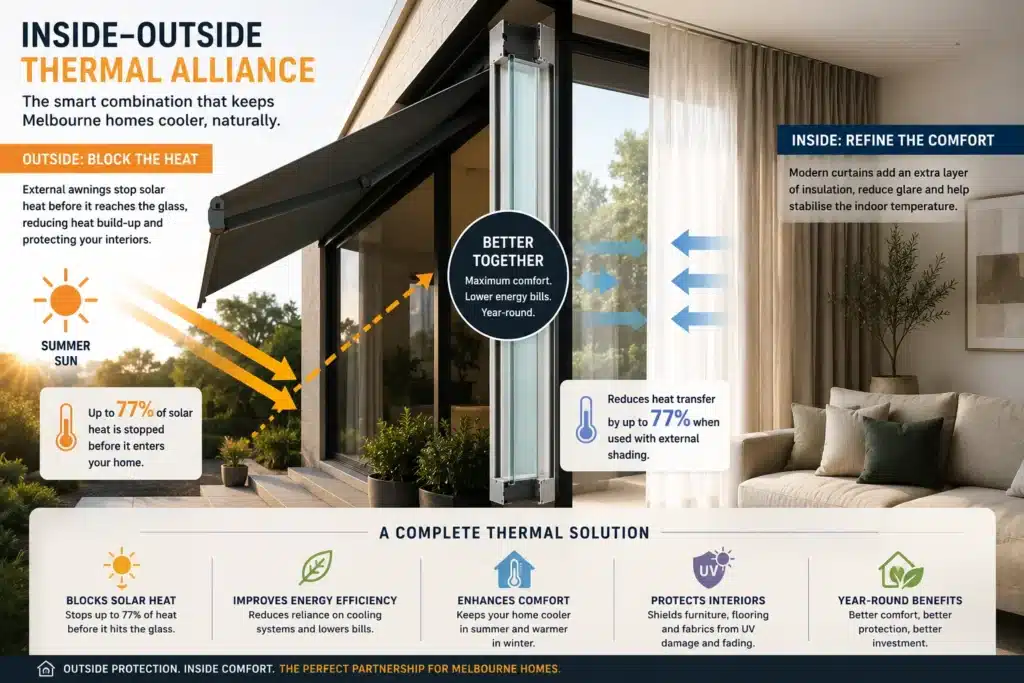
Awnings stop solar heat before it passes through the glass. Internal curtains then slow the remaining heat transfer and improve interior comfort. This is especially powerful on large north and west-facing windows.
For high-performance homes, pairing external awnings with modern curtains in Melbourne can reduce solar thermal gain by up to 77% before it fully impacts the internal living environment.
That matters during January and February.
Once heat enters the room, your split system has to work harder. If you stop the heat outside first, then use internal curtains to soften, insulate, and control glare, the entire home performs better.
This inside-outside pairing is especially effective for:
- Living rooms with large glazing
- Bedrooms exposed to afternoon sun
- Open-plan kitchen and dining areas
- Homes with polished concrete or timber floors
- Renovations where double glazing is not being upgraded
The best thermal outcome usually comes from layered thinking, not a single product.
The Factory-Direct Advantage from Ringwood
External shading systems must be made accurately.
A few millimetres out on an internal roller blind may be annoying. A few millimetres out on an external blind or awning can affect tension, tracking, operation, and longevity.
That is why factory-direct manufacturing matters.
Complete Blinds operates through a dedicated local factory hub in Ringwood, custom-crafting systems for Melbourne homes with the precision required for external conditions. We are not simply supplying generic imported products and hoping they fit.
We measure.
We assess the structure.
We manufacture to suit the opening.
We install with the local climate in mind.
This matters because cheap off-the-shelf imports commonly fail at predictable points:
- Fabric sagging
- Weak side retention
- Poor stitching
- Misaligned guides
- Loose brackets
- Inadequate fixing into timber, brick, or steel
- Motors not suited to load or exposure
- Premature UV breakdown
External systems are exposed to heat, moisture, wind, dust, and movement. They must be built properly from the beginning.
With more than 35 years of engineering experience, Complete Blinds understands how Melbourne homes actually behave. A coastal balcony in Brighton is not the same as a sheltered courtyard in Ringwood. A west-facing Glen Waverley family room is not the same as a shaded veranda in Box Hill.
Customisation is not a luxury here.
It is the difference between a system that lasts and one that disappoints.
Which One Should You Choose?
Choose outdoor blinds if your main goal is to create a more protected alfresco area.
They are the better option if you want:
- Wind control
- Insect protection
- Outdoor privacy
- A usable dining space
- Protection from sideways weather
- A semi-enclosed outdoor room
Choose awnings if your main goal is to control heat and sun before it hits the building.
They are the better option if you want:
- Reduced heat through windows
- Better summer comfort indoors
- Protection for flooring and furniture
- External shading for bedrooms or living areas
- Architectural façade improvement
- Flexible window sun management
Choose both if you are designing a premium home or renovation where comfort, thermal performance, and outdoor usability all matter.
That is often the smartest answer for high-end Melbourne properties.
Architectural FAQ: Outdoor Blinds vs Awnings
Outdoor blinds are generally better for enclosing alfresco areas in windy conditions, particularly Ziptrak outdoor blinds or other track-guided systems that reduce side movement. Awnings can also handle wind well when properly specified, especially fixed guide systems, but folding arm or loosely secured systems may need to be retracted during strong gusts. Wind exposure, fixing substrate, span, and product type all matter.
In many residential cases, external blinds and awnings do not require council approval if they are minor, non-structural additions. However, approval may be required if the system changes the building façade significantly, projects over boundaries, affects heritage overlays, or is part of a larger structural pergola or balcony alteration. Always check with your local council or builder, especially in heritage-sensitive suburbs.
Yes, outdoor blinds can often be retrofitted to existing pergolas, verandas, and alfresco structures. The key issue is whether the existing posts, beams, and fixing points are strong, square, and suitable for the system. If the structure has movement, uneven posts, or insufficient fixing surfaces, additional framing may be recommended before installation.
Yes, external awnings are generally better for reducing solar heat gain because they block sun before it reaches the glass. Indoor blinds still help with glare and comfort, but by the time sunlight has passed through glass, much of the heat has already entered the room. For maximum performance, combine external awnings with internal curtains or blinds.
Outdoor blinds can reduce rain intrusion significantly, especially wind-driven spray, but they should not be treated as waterproof walls. Performance depends on fabric type, side channels, bottom sealing, wind direction, and the structure around the blind. A well-designed system can make an alfresco space far more usable, but drainage and realistic weather expectations are still important.
Motorisation is strongly recommended for large systems, upper-storey installations, premium renovations, and homes where daily operation matters. It improves convenience and can help protect the product when paired with wind, sun, or rain sensors. Manual systems are still suitable for smaller, easy-to-reach applications, but motorisation is often the better long-term investment for high-use areas.
Final Recommendation for Melbourne Homes
The outdoor blinds vs awnings decision should be based on function first.
If you want to turn an exposed patio, pergola, balcony, or deck into a more comfortable outdoor room, choose outdoor blinds — especially Ziptrak outdoor blinds for track-guided protection.
If you want to stop heat before it hits your windows, protect your interiors from UV, and improve the thermal performance of your home, choose awnings.
For the best result, use both strategically.
Awnings protect the glass. Outdoor blinds protect the alfresco zone. Internal curtains complete the thermal system inside.
That is how premium Melbourne homes are being designed in 2026: layered, engineered, and built for real weather.
Building, renovating, or upgrading your alfresco space? Speak with the Complete Blinds team in Ringwood and get a custom, factory-direct solution designed for your home, your structure, and your local conditions.


