


Quick Verdict: Vertical blinds feature hanging fabric vanes that slide laterally, making them the superior choice for sliding doors and large expanses of glass. Venetian blinds use horizontal slats in timber, faux wood, or aluminium, offering precise tilt and filtered light, making them the classic choice for standard and tall windows alike.
Vertical blinds and Venetian blinds both rely on slats.
But the direction of those slats changes everything.
Vertical blinds create long lines from ceiling to floor. They make wide openings feel taller, cleaner, and easier to use. They also move in the same direction as sliding doors, which makes them one of the most practical choices for alfresco access, rental properties, and large living room glass.
Venetian blinds use horizontal slats. They create a sharper, more structured look and give you excellent control over light angle, privacy, and glare. That makes them useful for bedrooms, studies, bathrooms, kitchens, and street-facing windows.
The problem starts when the wrong slat direction goes onto the wrong window.
Put heavy Venetians on a high-traffic sliding door and you may fight with cords, stacking, weight, and access every day. Put dated vertical blinds on a feature window with the wrong fabric and the room can feel like an old office. Both mistakes cost money and weaken the room’s design.
Complete Blinds manufactures directly from our Ringwood factory, which gives Melbourne homeowners a major advantage. We can build extra-wide vertical tracks that run smoothly without jamming, and we can specify heavy-duty Venetian cord systems designed for daily use in real homes, not showroom-only conditions.
The goal is not just to choose the better blind.
The goal is to match the blind to the window, the room, and the way people actually move through the space.
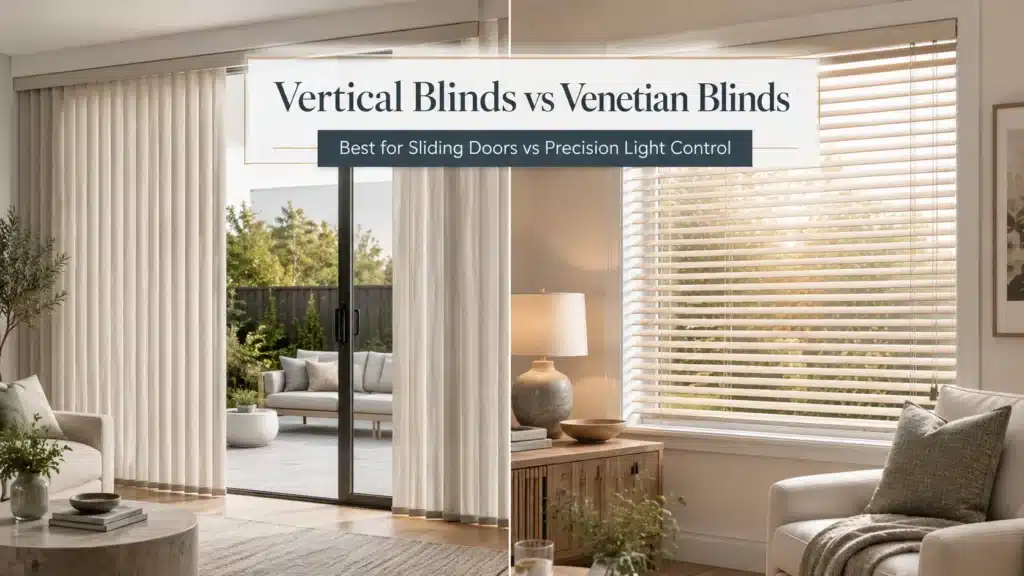
Vertical Blinds: The Wide-Span Specialist
Vertical blinds work best where width, access, and movement matter.
The system uses hanging fabric vanes connected to a headrail. You can tilt the vanes to control privacy and light, then draw them sideways to open the window or door. Depending on the opening, the blind can stack to the left, stack to the right, or split from the centre.
That lateral movement makes vertical blinds highly practical for sliding doors.
The blind moves in the same direction as the door. You can walk in and out without lifting a heavy blind up and down. For large alfresco doors, rental properties, family rooms, and high-use living areas, that simple detail matters.
Vertical blinds also handle large glass more economically than many other options.
A wide sliding door may need multiple roller blinds or a more expensive curtain system. A single vertical blind track can often cover the same area with fewer complications. That makes verticals a smart choice for property managers, investors, and homeowners who need functional coverage across big spans.
Modern vertical blinds also look very different from the stiff office-style blinds many people remember.
The 2026 trend is softer and more residential. Premium textured fabrics, translucent weaves, warm neutrals, and subtle blockout options now give vertical blinds a far more refined look. Some fabrics mimic the softness of curtains while keeping the practical track-based movement of a blind.
Vertical lines also affect room perception.
They draw the eye upward. In rooms with standard ceiling heights, this can make the space feel taller. In open-plan living areas, vertical blinds can help large glass doors feel cleaner and more architectural.
For homeowners searching for custom vertical blinds in Melbourne, custom manufacturing makes a major difference. Cheap tracks can feel loose, noisy, or uneven. Poorly weighted vanes can twist. Incorrect measuring can leave gaps or create awkward stacking.
A properly made vertical blind should glide smoothly, rotate evenly, and stack where it causes the least disruption.
That is especially important for wide doors, bifolds, and large windows where small manufacturing errors become very obvious.
Venetian Blinds: The Light Control Masters
Venetian blinds give you one of the most precise light-control systems available.
They use horizontal slats that tilt up and down. That tilt mechanism lets you redirect sunlight instead of simply blocking it. You can angle the slats upward to protect privacy from the street. You can tilt them downward to reduce glare aslo open them fully for daylight or close them tightly for more privacy.
This level of control suits Melbourne conditions.
Summer sun can be harsh, especially on west-facing windows. A Venetian blind lets you cut glare without making the room completely dark. In winter, you can open the slats to bring in more light and warmth during the day, then close them for privacy at night.
Venetians also allow airflow better than many solid fabric blinds.
Because the slats tilt, you can keep a window partly open while still controlling privacy. This works well in bedrooms, bathrooms, kitchens, and home offices.
Material choice matters.
Natural timber gives Venetian blinds a warmer, more premium look. Timber venetian blinds suit living rooms, bedrooms, studies, and homes with timber flooring, natural stone, neutral palettes, or classic detailing.
Faux wood Venetian blinds offer a more durable alternative. They give a similar wide-slat appearance but resist moisture better than natural timber. This makes them useful for bathrooms, laundries, kitchens, and rental properties.
Aluminium Venetians suit a different brief. They look slimmer, sharper, and more contemporary. They also handle moisture well and suit compact windows, offices, bathrooms, and modern apartments.
The aluminium Venetian blinds pros and cons usually come down to practicality versus softness.
On the positive side, aluminium Venetians are durable, moisture-resistant, cost-effective, and highly adjustable. On the negative side, they can feel colder or noisier than timber or faux wood options if used in the wrong room.
Venetian blinds also have one major limitation.
They are not ideal for large sliding doors.
A wide Venetian blind becomes heavy. It must lift vertically, which can make daily access awkward. On a busy sliding door, this creates unnecessary strain on the cords, the slats, and the user.
Venetians perform best on standard windows, tall narrow windows, wet-area windows, and spaces where light angle matters more than full doorway access.
Vertical Blinds vs Venetian Blinds: Technical Head-to-Head
| Comparison Point | Vertical Blinds | Venetian Blinds |
|---|---|---|
| Cost per Square Metre | Usually cost-effective for large glass spans because one track can cover a wide opening. | Often affordable on standard windows, but large widths can become heavier and more expensive. |
| Dust Accumulation | Collect less dust because the vanes hang vertically and gravity helps keep surfaces clearer. | Collect more dust because horizontal slats act like shelves. They need more regular wiping or vacuuming. |
| Cleaning Difficulty | Easier for dust control, but stains on fabric vanes may need spot-cleaning or vane replacement. | More time-consuming because each slat needs attention, especially in kitchens or dusty rooms. |
| Suitability for Sliding Doors | Excellent. They slide sideways with the door and allow easy access. | Poor to moderate. Large Venetians can become heavy and awkward on high-traffic doors. |
| Precision of Light Control | Good. Tilting vertical vanes controls privacy and light across wide openings. | Excellent. Horizontal slats offer finer control over glare, privacy, and sun angle. |
| Wind Resistance | Can move or rattle near open doors if exposed to strong airflow. Bottom weights and quality tracking help. | More stable on smaller windows, but lightweight aluminium slats may rattle in breezy conditions. |
| Best Window Type | Sliding doors, bifold doors, large windows, rental properties, wide living room glass. | Standard windows, tall windows, bathrooms, kitchens, studies, bedrooms, and street-facing rooms. |
| Main Functional Risk | Cheap tracks can jam or feel flimsy on wide openings. | Large blinds can become heavy, dusty, and inconvenient on doors. |
| Best Design Effect | Creates long vertical lines and makes spaces feel taller. | Creates structured horizontal lines and precise light filtering. |
| Motorisation Suitability | Possible, especially on wide tracks, but depends on track design and use case. | Possible in selected applications, but rollers and some other systems often automate more cleanly. |
The 2026 Design and Melbourne Suburb Filter
Melbourne’s housing mix makes this comparison more interesting.
A coastal-style home in Mornington does not need the same blind style as a new estate home in Melbourne’s outer east. A Bayside renovation with white interiors and wide windows may suit faux wood Venetians, while a large family home with alfresco doors may need vertical blinds for practical movement.
In Mornington, Bayside, Sandringham, Brighton, Hampton, and Beaumaris, many homeowners want a light, coastal, plantation-style look without paying for full shutters across every window.
This is where wide-slat faux wood Venetian blinds work well.
A crisp white 50mm or wider slat can create a shutter-inspired appearance at a lower price point. It gives bathrooms, bedrooms, and living areas a clean coastal feel while still allowing precise tilt control.
Faux wood also handles moisture better than natural timber, which makes it practical near sea air, bathrooms, kitchens, and laundries.
For homeowners who want the true premium version of this look, Plantation Shutters remain the stronger architectural upgrade. They offer a more permanent, built-in finish and work beautifully in high-end homes, wet areas, and street-facing rooms.
In Melbourne’s outer east, including Ringwood, Croydon, Lilydale, Wantirna, Ferntree Gully, Rowville, and new family estates, the challenge often comes from large open-plan living spaces.
These homes commonly include wide sliding doors to alfresco areas. Some have entire rear walls of glass.
Vertical blinds suit these openings because they cover large spans without creating heavy lift systems. They also allow families to move in and out easily.
A sleek vertical track with modern textured vanes can look clean and intentional, especially in neutral interiors. The result feels softer than a bare roller system but more practical than heavy horizontal slats across a doorway.
Room-by-Room Recommendations
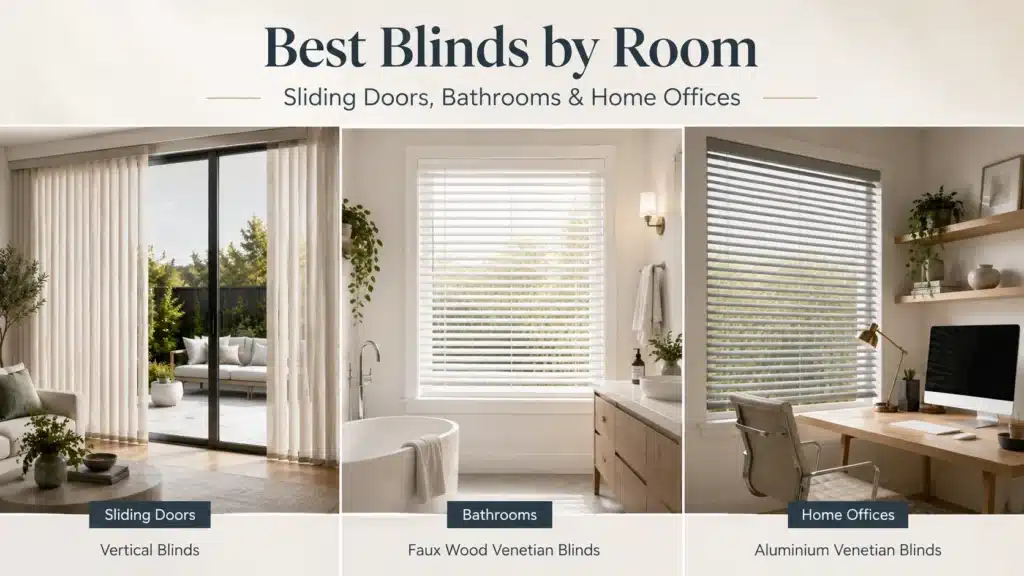
Sliding and Bifold Doors
Vertical blinds win clearly for sliding and bifold doors.
The reason is simple: access.
Sliding doors move sideways. Vertical blinds also move sideways. That matching movement makes daily use easier.
You can part the vanes, walk through the doorway, and close them again without raising a large blind. In family homes, rental properties, and alfresco zones, this convenience makes a major difference.
Venetian blinds can technically go on some large doors, but they rarely offer the best result.
A wide Venetian blind becomes heavy. It can strain the cords, may sit awkwardly when raised. It also creates a stack at the top, which can interfere with door use or reduce the clean look of the opening.
For bifold doors, vertical blinds also offer flexibility because the blind can stack away from the main traffic path.
The key is track quality.
A wide vertical blind needs a strong headrail, correct brackets, smooth carriers, and proper vane spacing. Complete Blinds can manufacture extra-wide tracks from our Ringwood factory to suit large Melbourne door openings without the flimsy feel of cheap imported systems.
Bathrooms and Kitchens
Bathrooms and kitchens need materials that can handle moisture, steam, cleaning, and daily use.
Faux wood Venetians and aluminium Venetians usually dominate these areas.
Faux wood Venetian blinds give a warmer look while resisting moisture better than natural timber. They suit bathrooms, laundries, powder rooms, and kitchens where homeowners want a classic slatted appearance.
Aluminium Venetians offer a sleeker and more practical option. They resist moisture, suit smaller windows, and clean more easily than fabric products.
Vertical blinds can work in some kitchens with larger glass doors, but fabric vanes need more caution. Cooking oils, steam, and stains can affect the fabric over time.
Natural timber Venetians also need caution in wet zones.
Timber looks beautiful, but moisture can affect it if the room lacks ventilation. For bathrooms, laundries, and splash-prone kitchens, faux wood or aluminium usually performs better.
Home Offices and Studies
Venetian blinds are excellent for home offices.
Screen glare creates one of the biggest problems in a study. A roller blind may force you to choose between too much light and not enough light. A Venetian blind gives more control.
You can tilt the slats in small increments to redirect sunlight away from the screen while still keeping natural light in the room.
This makes Venetians useful for desks near windows, street-facing offices, and rooms used for video calls.
They also help with privacy. You can angle the slats so people outside cannot see directly in, while the room still receives daylight.
Vertical blinds can work in a study if the room has a wide sliding door or large glass panel. But for standard study windows, Venetians usually provide better light control.
The Maintenance Reality Check
Maintenance should influence your decision.
Venetian blinds look sharp, but they collect dust.
Every horizontal slat acts like a small shelf. Dust settles across the surface, especially in bedrooms, offices, kitchens, and rooms near busy roads. If the window stays open often, the build-up can happen faster.
Cleaning Venetians takes patience.
You need to close the slats one way, wipe or vacuum them, then reverse the slats and repeat. Faux wood and aluminium options clean more easily than some timber finishes, but they still need regular attention.
Vertical blinds collect far less dust.
Because the vanes hang vertically, gravity helps dust fall away instead of sitting on the surface. This makes vertical blinds easier to maintain for general dust control.
However, vertical blinds have a different issue.
If a fabric vane gets stained, you may need to spot-clean it carefully. Some stains can be difficult to remove, depending on the fabric. In rental properties or family homes, the ability to replace individual vanes can be useful.
Here is the honest installer’s advice.
Choose Venetians if you want precision light control and you accept the cleaning routine. Choose vertical blinds if you want easier dust management across a large glass area and can avoid heavy staining.
Motorisation and Smart Home Integration
Modern Melbourne homeowners increasingly ask about automation.
Both vertical and Venetian blinds can support automation in selected situations, but they do not behave the same way.
Vertical blinds can use motorised tracking systems to draw the vanes open and closed. Some systems can also tilt the vanes. This can work well for very wide doors, high windows, or homes where convenience matters.
Venetian blinds can also be automated, particularly for tilt control. However, lifting horizontal slats creates more mechanical load than tilting them.
For many projects, motorised blinds work best when the system design matches the window type. Roller blinds often provide the simplest automation platform, while verticals and Venetians need more careful planning.
If automation sits high on the wish list, discuss it before choosing the blind style.
The motor, track, wiring, battery access, control method, and daily use pattern all affect the final recommendation.
Venetian vs Vertical Blinds Cost
Venetian vs vertical blinds cost depends on the size of the window, material, track or cord system, fabric choice, installation method, and whether the blind includes automation.
For large sliding doors, vertical blinds often offer better value.
One vertical system can cover a wide opening without requiring multiple blinds or a heavy lift mechanism. This makes verticals practical for rental properties, alfresco doors, and wide family living areas.
For standard windows, Venetian blinds can be very cost-effective.
Aluminium Venetians usually sit at the lower-cost end. Faux wood Venetians cost more but offer better durability and style for many homes. Natural timber Venetians sit higher again because they deliver a warmer, more premium finish.
The cheapest blind is not always the best value.
A low-cost vertical track that jams will annoy you every day. A weak Venetian cord system on a large window can fail early. A poorly chosen material in a wet area can warp, stain, or deteriorate.
Complete Blinds focuses on custom production from our Ringwood factory so the system matches the actual job. That includes wide vertical tracks that run smoothly and Venetian hardware designed to handle daily Melbourne use.
FAQs: Vertical Blinds vs Venetian Blinds
No. Vertical blinds are not out of style, but the old office-style versions are.
Modern vertical blinds use better fabrics, softer textures, cleaner tracks, and more residential colours. In 2026, they remain one of the most practical options for wide sliding doors and large glass openings in Melbourne homes.
You can, but it is rarely the best choice.
Large Venetian blinds become heavy and awkward on sliding doors. They lift vertically, while the door moves sideways. That mismatch can make daily access frustrating.
For sliding glass doors, vertical blinds usually work better because they move in the same direction as the door.
It depends on the window size and material.
Vertical blinds often provide better value across large sliding doors and wide glass spans. Aluminium Venetians can be cheaper on smaller windows, while faux wood and timber Venetians usually cost more.
For an accurate comparison, measure the actual windows and compare like-for-like material quality.
Venetian blinds can help reduce some heat loss by creating a layer between the room and the glass, but they do not insulate as strongly as heavier lined fabrics or cellular-style blinds.
Timber and faux wood slats may feel more thermally comfortable than thin aluminium. For strong winter insulation, consider the whole window furnishing system, not just the slat style.
The maximum width depends on the track system, vane weight, control type, and installation surface.
Large tracks need stronger hardware and accurate installation. Complete Blinds can manufacture extra-wide vertical tracks through our Ringwood factory for large Melbourne openings, but the final specification should suit the exact span and daily use.
Close the slats and remove dust with a microfibre cloth, soft duster, or vacuum brush attachment.
Then tilt the slats the opposite way and repeat. For marks, use a lightly damp cloth and mild cleaning solution. Avoid soaking the slats or using harsh chemicals, especially around cords and mechanisms.
Final Recommendation
Choose vertical blinds if you need to cover sliding doors, bifold doors, wide windows, or large glass spans.
They offer strong value, easy sideways access, good privacy, and a cleaner solution for high-traffic openings.
Choose Venetian blinds if you want precise control over light, glare, airflow, and privacy on standard windows.
Timber Venetians suit warmer and more premium interiors. Faux wood Venetians suit wet areas, coastal homes, and busy households. Aluminium Venetians suit sleek, practical, and cost-conscious spaces.
For many Melbourne homes, the best result uses both styles strategically.
Use vertical blinds where the architecture moves sideways. Use Venetian blinds where the room needs accurate slat control.
With custom manufacturing from Complete Blinds in Ringwood, both options can be built to fit properly, operate smoothly, and handle the daily wear and tear of a real Melbourne home.


