


Quick Verdict: Outfitting a Melbourne home in 2026 typically costs between $150 and $450 per window for custom roller blinds, $350 to $800 for plantation shutters, and $400 to $1,200+ for premium S-Fold sheer curtains. Current trends favour dual-layered treatments, concealed blockouts and smart motorisation for modern luxury, privacy and thermal performance.
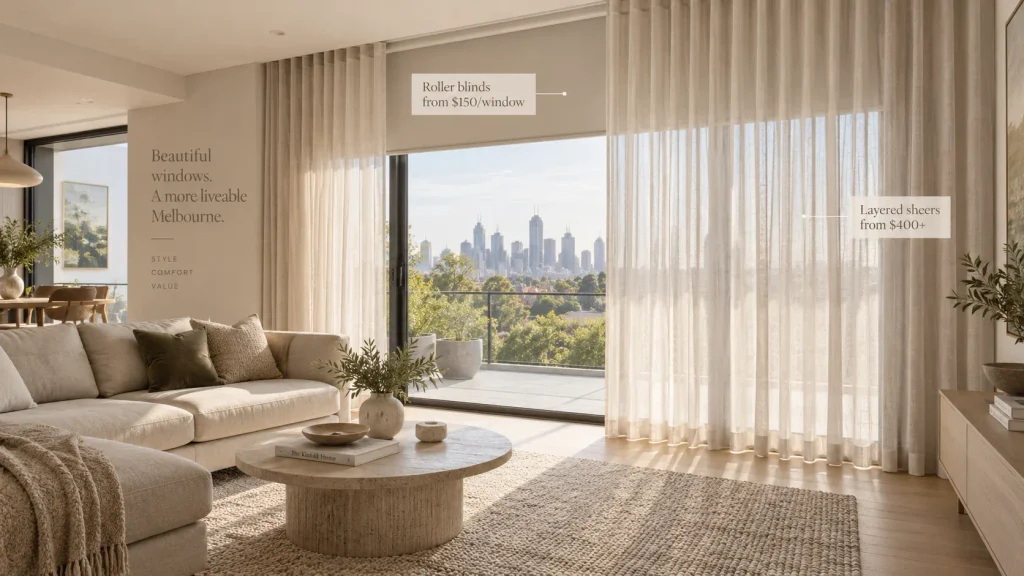
Understanding blinds cost Melbourne per window helps homeowners plan properly before building, renovating or replacing old window coverings.
The real cost depends on more than fabric. Window size, installation method, operation type, material quality, room function and architectural complexity all influence the final quote. A small bedroom roller blind will not cost the same as a full-height S-Fold sheer curtain across a large sliding door. A manual chain-operated blind will not cost the same as a motorised system connected to a smart home.
Melbourne homes also vary widely. A compact inner-city apartment, a restored Edwardian home in Camberwell, a family home in Ringwood, and a new architectural build in Doncaster all need different window furnishing strategies.
Complete Blinds manufactures directly from our Ringwood factory, which means every blind, curtain and shutter can be measured, cut and installed to suit the actual window opening. That matters because cheap store-bought imports often leave micro-gaps, fade under Australian UV, and fail earlier through weak mechanisms.
This guide explains the leading window furnishing trends Melbourne homeowners are choosing in 2026, with practical cost ranges per window and whole-home project estimates.
The 2026 Melbourne Design Shift: Function Meets Modern Elegance
Melbourne window furnishing design has moved beyond single-purpose blinds.
A decade ago, many homes used one basic covering per room: a roller blind in the bedroom, a Venetian in the kitchen, or a curtain in the living room. The priority was often privacy first, style second.
That has changed.
Modern homeowners now expect window furnishings to perform as part of the architecture. They need to control heat, glare, privacy, acoustics and light while also supporting the interior design.
This is why layered window treatments have become so popular.
A sheer curtain can soften daylight. A concealed roller blind can provide night-time privacy or blockout. A lined curtain can improve insulation. A motorised system can handle large windows or daily automation.
Melbourne interiors are also becoming warmer and more tactile. Cool grey has lost ground to softer neutrals and natural textures.
Popular palettes now include:
- Warm greige
- Oatmeal
- Mushroom
- Clay
- Soft taupe
- Natural linen
- Muted sage
- Warm white
Hardware is also more considered. Matte black works well in modern and industrial homes. Soft brass suits warmer interiors. White and off-white tracks blend into plaster ceilings for a cleaner architectural finish.
The best results come from matching the product to the room’s style, orientation and function rather than choosing the cheapest covering available.
Top 4 Window Furnishing Trends Dominating Melbourne Interiors
Trend 1: The Layered Look
The leading trend in Melbourne homes is the layered look: S-Fold sheers paired with slimline blockout roller blinds.
This combination works because each layer does a different job.
The sheer curtain softens daylight, adds movement and creates privacy during the day. The blockout roller blind provides night-time privacy, room darkening and stronger light control.
In living rooms, this setup creates a high-end designer look without feeling heavy. In master bedrooms, it gives the room softness during the day and darkness at night.
The most common arrangement is:
- Ceiling-mounted S-Fold sheer curtain
- Concealed or recess-fitted blockout roller behind
- Warm neutral sheer fabric
- Blockout roller colour matched to the wall or window frame
- Optional motorisation for large openings
This layered approach suits contemporary homes, townhouses, new builds and renovated period homes with modern rear extensions.
It is also practical for Melbourne’s climate. The additional fabric layer helps soften heat, glare and acoustic sharpness in open-plan spaces.
Trend 2: Integrated Smart Motorisation
Motorisation is no longer limited to luxury homes.
Melbourne homeowners now choose motorised blinds for large sliding doors, high windows, bedrooms, media rooms and open-plan living areas. The appeal is simple: better control with less effort.
Motorised blinds can operate by remote, wall switch, app, timer or smart home system. Some systems use hard-wired motors, while others use battery or solar-rechargeable options.
Smart motorisation is especially useful for:
- Large glazing
- High or hard-to-reach windows
- West-facing rooms
- Bedrooms
- Elderly-friendly homes
- Child-safe designs
- New builds with automation planning
The cost is higher than manual operation, but the value is strongest where blinds need to move daily. A west-facing living room can close before afternoon heat becomes uncomfortable. Bedrooms can open gradually in the morning. Media rooms can switch to dark mode at the press of a button.
In larger projects, automation also creates a cleaner interior because chains are removed.
Trend 3: Architectural Plantation Shutters
Plantation shutters remain one of Melbourne’s most enduring window furnishing choices.
They suit street-facing rooms, bathrooms, coastal homes, Hamptons interiors and high-end renovations. Their main appeal is structure. Unlike soft fabrics, shutters feel built into the window.
White shutters remain the classic option, especially for front bedrooms, bay windows and homes with traditional facades. Stained timber or warmer finishes can work in heritage homes, coastal interiors and more architectural spaces.
Homeowners researching plantation shutters cost should understand that shutters usually sit in a higher price bracket than basic roller blinds. However, they offer strong durability, privacy, ventilation and street appeal.
They are particularly effective for:
- Front-facing bedrooms
- Bathrooms
- Kitchens
- Coastal homes
- Street-facing living rooms
- Hamptons-style renovations
- Multi-storey homes needing facade consistency
Shutters cost more upfront, but they often last longer than many softer window coverings when specified correctly.
Trend 4: Energy-Saving Cellular Shades
Honeycomb or cellular blinds are gaining popularity because of their insulation performance.
Their structure includes hexagonal air pockets that trap still air. This helps reduce heat transfer through the window area, making them useful in cold bedrooms, older homes and single-glazed properties.
Melbourne homeowners often choose cellular blinds for rooms that feel cold in winter or overheated in summer.
They suit:
- South-facing bedrooms
- Nurseries
- Home offices
- Older single-glazed homes
- Apartments
- Cold rooms in eastern suburbs
- Energy-conscious renovations
They do not have the same soft decorative effect as curtains, but they offer a clean, compact look with strong performance.
For homeowners comparing the best value for thermal improvement, cellular blinds often sit between roller blinds and more premium layered curtain systems.
Realistic Melbourne Cost Breakdown: Per Window and Whole House
Window furnishing prices vary widely, but transparent ranges help with planning.
The following figures are general Melbourne guide ranges only. Final pricing depends on size, fabric, hardware, installation complexity and product specification.
Per-Window Cost Ranges
Custom Roller Blinds: $150 – $450+ per window
Roller blinds are usually the most cost-effective custom option.
A simple small roller blind may sit near the lower end of the range. Larger windows, premium fabrics, sunscreen and blockout combinations, cassette systems, pelmets or motorisation will increase the cost.
Roller blinds offer strong value because they are practical, modern and adaptable across many room types.
Best for:
- Bedrooms
- Apartments
- Living rooms
- Studies
- Investment properties
- New builds
Timber or PVC Plantation Shutters: $350 – $800+ per window
Plantation shutters cost more because they require a framed system, louvres, custom panel sizing and precise installation.
The final price depends on window size, material, configuration, frame type and whether the opening requires special shapes or multiple panels.
Shutters are usually a premium investment, but they provide long-term value in high-use rooms.
Best for:
- Bathrooms
- Front bedrooms
- Coastal homes
- Street-facing windows
- Hamptons and heritage-inspired interiors
Custom S-Fold Sheers and Drapes: $400 – $1,200+ per window
Premium curtains vary significantly in price because fabric quantity, track style, lining, fullness and installation height all matter.
A small sheer curtain may sit at the lower end. A full-height S-Fold sheer across a large sliding door, especially with blockout lining or a dual-track system, can cost considerably more.
Modern curtains in Melbourne are often chosen for living rooms, master bedrooms and open-plan spaces because they transform the room visually.
Best for:
- Living rooms
- Master suites
- Dining rooms
- Large sliding doors
- Architectural homes
- Luxury renovations
Honeycomb or Cellular Shades: $250 – $600+ per window
Honeycomb blinds usually cost more than basic roller blinds but less than many premium curtain systems.
The price depends on fabric type, cell structure, operation style, window size and whether blockout or light-filtering fabric is selected.
Best for:
- Cold bedrooms
- Nurseries
- Home offices
- Single-glazed windows
- Thermal upgrades
Whole-House Budgeting Estimates
3-Bed Townhouse or Apartment: 8–10 Windows
Estimated range: $2,500 – $5,500
This usually covers a practical mix of roller blinds, sunscreen blinds, bedroom blockouts or a few upgraded feature areas.
A townhouse with simple roller blinds throughout will sit closer to the lower end. Adding sheers to living areas or shutters to street-facing rooms will increase the budget.
Standard 4-Bed Family Home: 12–16 Windows
Estimated range: $4,500 – $9,500
The cost to outfit 4 bedroom house blinds Melbourne homeowners should expect depends heavily on product mix.
A common combination may include:
- Blockout roller blinds in bedrooms
- Sunscreen or dual rollers in living areas
- Shutters in bathrooms or front rooms
- Sheers across the main living area
This creates a balanced result without over-spending in every room.
High-End Custom Architectural Build: 18+ Windows
Estimated range: $10,000 – $22,000+
Architectural homes often include large glazing, multiple sliding doors, high windows, motorisation, recessed tracks, pelmets and layered window treatments.
These projects cost more because the installation and product specification are more complex.
The budget may include:
- Motorised rollers
- Ceiling-recessed S-Fold curtains
- Dual-track systems
- Shutters in selected rooms
- Smart home integration
- Large-span custom hardware
- Premium fabric selections
For new builds, early planning can help avoid expensive compromises later.
Key Price Drivers: What Changes the Final Quote?
Understanding blinds cost Melbourne per window means understanding what sits behind the number.
Two windows may look similar at first glance but require very different products, brackets, fabrics or installation methods.
1. Fabric Quality and Light Control
Fabric is one of the largest cost variables.
A standard translucent fabric usually costs less than a premium blockout, acoustic, textured sheer or commercial-grade weave.
Light control also affects cost.
A basic privacy blind is usually cheaper than a dual roller system. A blockout curtain with lining costs more than a light sheer. A technical sunscreen fabric with better UV and glare performance may cost more than a simple plain fabric.
Higher-quality fabrics usually offer better:
- UV resistance
- Colour stability
- Fabric tension
- Light control
- Thermal performance
- Durability
- Interior finish
Cheap fabrics may look acceptable at first, but they can fade, curl or degrade faster under Australian sun.
2. Operation Type
Manual chain operation is usually the most affordable choice for roller blinds.
However, motorisation changes the budget.
A motorised blind includes the motor, power source, controls and additional setup. Hard-wired systems may also require electrical coordination. Battery or solar-rechargeable systems may reduce wiring needs but still cost more than manual blinds.
Motorisation makes the most sense where:
- The window is large
- The blind is heavy
- The window is hard to reach
- Several blinds operate together
- Child safety is a priority
- Smart home control is desired
In high-end builds, motorisation is often planned from the start rather than added later.
3. Window Depth, Size and Installation Complexity
Installation type can significantly affect price.
A simple recess-fit roller blind on a standard window is usually straightforward. However, large sliding doors, angled reveals, tiled bathrooms, high windows or non-square frames require more time and care.
Common installation variables include:
- Recess fit
- Face fit
- Ceiling mount
- Wall mount
- Pelmet boxes
- Recessed tracks
- Side channels
- Large-span tubes
- Split blinds
- Multi-panel shutters
- Difficult access
A large window also needs stronger hardware. Wider blinds may require heavier tubes to prevent sagging.
This is one reason factory-direct measurement matters. Custom sizing reduces the risk of poor fit and avoids unnecessary compromises during installation.
4. Ringwood Manufacturing vs Pre-Cut Retail Imports
A pre-cut retail blind is cheaper because it is built to standard dimensions and limited specifications.
A custom-made blind is different.
Complete Blinds manufactures through our Ringwood factory, allowing each product to suit the actual window opening. That means better fit, stronger performance and a more professional finish.
Custom manufacturing can control:
- Width and drop
- Fabric selection
- Bracket type
- Base rail finish
- Track colour
- Pelmet size
- Motor compatibility
- Shutter configuration
- Curtain fullness
- Installation method
This is especially important in Melbourne homes where older frames, renovation movement, heritage details and modern large glazing often create non-standard conditions.
Cost vs Value Comparison Matrix
| Furnishing Type | Average Price Range per Window | Estimated Lifespan | Thermal Insulation Rating | Best Suited Room Application |
|---|---|---|---|---|
| Custom Roller Blinds | $150 – $450+ | 7–12 years | ★★☆☆☆ to ★★★☆☆ | Bedrooms, studies, apartments, living rooms |
| Dual Roller Blinds | $300 – $700+ | 7–12 years | ★★★☆☆ | Bedrooms, living rooms, home offices |
| Honeycomb / Cellular Blinds | $250 – $600+ | 8–12 years | ★★★★☆ | Cold rooms, nurseries, single-glazed windows |
| Plantation Shutters | $350 – $800+ | 10–20 years | ★★★★☆ | Bathrooms, front rooms, coastal homes |
| S-Fold Sheer Curtains | $400 – $1,200+ | 8–15 years | ★★☆☆☆ to ★★★☆☆ | Living rooms, master bedrooms, sliding doors |
| Lined Blockout Curtains | $600 – $1,500+ | 8–15 years | ★★★★☆ | Bedrooms, theatres, formal living areas |
| Motorised Roller Blinds | $500 – $1,200+ | 7–12 years | ★★★☆☆ | Large glazing, high windows, smart homes |
The True Cost of Cheap Imports vs Ringwood Custom Manufacturing
A $50 store-bought blind can look tempting.
For a short-term rental room or temporary solution, it may be enough. But in a permanent Melbourne home, cheap imports often cost more over time.
The common problems include:
- Weak mechanisms
- Poor fabric tension
- Early fading
- Curling edges
- Sagging roller tubes
- Limited sizes
- Light leakage around edges
- Poor thermal control
- No proper installation support
- Short lifespan
Micro-gaps are a major issue.
A ready-made blind may not fit the opening correctly. Even a small gap beside the fabric can create light bleed, privacy problems and heat transfer. Micro-gaps are a major issue.
A ready-made blind may not fit the opening correctly. Even a small gap beside the fabric can create light bleed, privacy problems and heat transfer.
That gap can ruin sleep quality in bedrooms, create glare across living rooms, and allow cold air to move around the window during winter.
Cheap fabrics also struggle under Australian UV.
Melbourne may be known for changeable weather, but the sun can still be harsh. Low-quality fabric can fade or weaken quickly, especially on north and west-facing windows.
Ordering quality blinds Melbourne homeowners can rely on means investing in correct fitment, suitable materials and long-term support.
Complete Blinds manufactures directly from Ringwood, giving customers access to local measurement, custom production, professional installation and warranty support.
That factory-direct model reduces the risk of buying a blind that looks fine online but performs poorly once installed.
How to Budget Smartly Room by Room
Not every room needs the same level of investment.
A smart budget usually places premium products where they matter most and practical products where performance is enough.
Bedrooms
Prioritise privacy, darkness and comfort.
Good options include:
- Blockout roller blinds
- Honeycomb blinds
- Lined curtains
- Dual roller systems
Spend more here if sleep quality matters.
Living Areas
Prioritise style, glare control and softness.
Good options include:
- S-Fold sheers
- Sunscreen rollers
- Layered roller and curtain systems
- Motorised blinds for large openings
This is often where homeowners choose the most visually refined solution.
Bathrooms and Laundries
Prioritise moisture resistance.
Good options include:
- PVC shutters
- Aluminium Venetians
- Suitable roller blind fabrics
Avoid heavy soft fabrics in wet areas unless the ventilation is excellent.
Home Offices
Prioritise glare control and screen comfort.
Good options include:
- Sunscreen roller blinds
- Dual rollers
- Venetians
- Cellular blinds for cold rooms
A home office often benefits from flexible daylight control rather than full blockout only.
Frequently Asked Questions
A standard 4-bedroom Melbourne home with 12–16 windows usually costs around $4,500 to $9,500, depending on product choice. Roller blinds sit lower, while shutters, curtains and motorisation increase the budget.
It depends on window size and fabric selection. Plantation shutters often cost more per window than simple sheers, but premium full-height curtains can also become expensive. Shutters usually provide stronger structure, while sheers create a softer designer finish.
Yes. Motorised blinds cost more because they include motors, controls and setup. However, they add strong value for large windows, high openings, smart homes and child-safe interiors.
Start planning at least 6–8 weeks before handover, or earlier if you want motorisation, recessed tracks, pelmets or custom curtains. Early planning avoids visible wiring, rushed choices and poor bracket placement.
Yes. Most well-designed homes mix products by room function. Use a consistent colour palette, similar hardware finishes and a clear design logic. For example, rollers in bedrooms, sheers in living areas and shutters in bathrooms can work beautifully together.
Final Cost Recommendation
The best window furnishing budget is not about choosing the cheapest product for every window.
It is about spending intelligently.
Use cost-effective roller blinds where clean privacy and light control are enough. Invest in sheers or lined curtains where the room needs softness and design impact. Choose shutters where durability, moisture resistance and facade presentation matter. Add cellular blinds where thermal comfort is the priority. Use motorisation where daily operation, height or convenience justify the upgrade.
For homeowners comparing blinds cost Melbourne per window, the most important lesson is simple: the final quote should reflect the window, the room and the long-term performance you expect.
Complete Blinds can help you balance style, cost and function with factory-direct manufacturing from our Ringwood facility. Our team can measure your windows, recommend suitable products, and provide a clear quote based on your home, budget and design goals.
If you are planning a new build, renovation or window furnishing upgrade, contact Complete Blinds today or fill out the form below. Our team will review your enquiry and help you choose the right solution for your Melbourne home.


