


Quick Verdict: Blinds offer sleek functionality and budget control; curtains provide soft, architectural luxury and acoustic dampening; shutters act as permanent, high-value furniture for your windows. The best Melbourne homes rarely pick one. They use a strategic hybrid approach across rooms, balancing privacy, insulation, light control, moisture resistance, resale value, and the way each space actually lives day to day comfortably indoors.
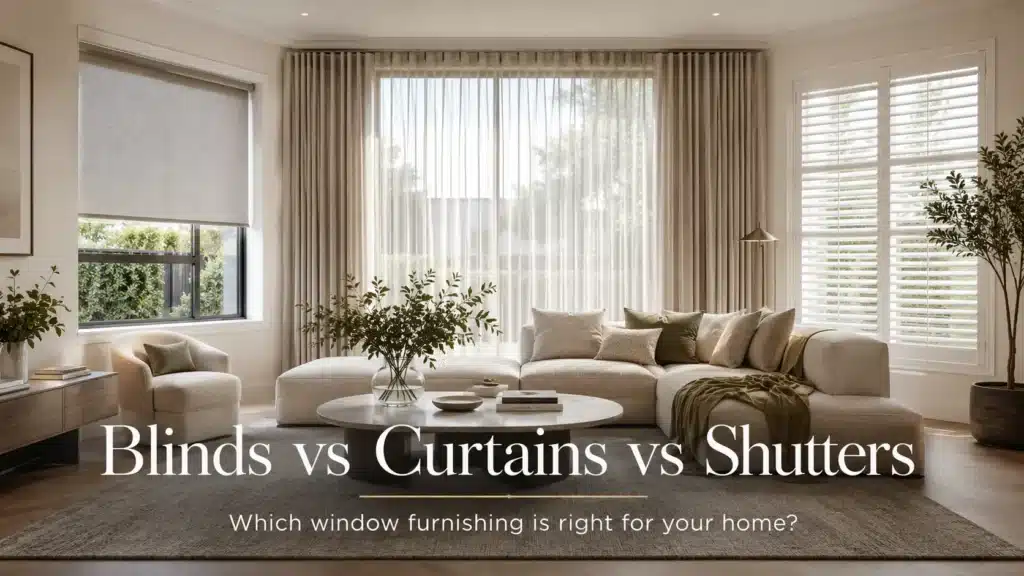
Choosing between blinds vs curtains vs shutters can feel overwhelming because this decision affects every room in the house.
It shapes how your home looks from the street. It controls how much heat enters in summer. It affects privacy at night, glare during the day, bedroom darkness, maintenance, acoustics, and long-term property value.
Yet many homeowners leave window furnishings until the final stage of a new build or renovation.
That creates problems.
By the time flooring, cabinetry, paint colours, lighting, and furniture have been selected, the window coverings often need to “fit in” around finished decisions. That can lead to rushed choices, uneven room design, or products that look right but fail technically.
A good window furnishing plan starts much earlier.
You need to know which windows need full blockout, which ones need filtered light, which spaces need softness, which wet areas need moisture resistance, and which street-facing rooms need kerb appeal.
At Complete Blinds, we manufacture and supply blinds, curtains, and shutters through our Ringwood facility. That gives our team a major advantage.
We do not need to push one product line over another.
Instead, we assess the architecture, window depth, orientation, room use, budget, and design intent. Then we recommend the right mix. For many Melbourne homes, that mix includes all three options.
Blinds: The Functional Workhorses
Blinds are the most versatile foundation layer in modern window furnishing design.
They suit almost every home type, from apartments and townhouses to large new builds and family renovations. They control light precisely, fit neatly into window openings, and usually cost less than curtains or shutters.
This makes them especially valuable when you need to cover many windows without losing design control.
Roller blinds remain the most popular blind style for Melbourne homes because they look clean, operate easily, and suit both minimal and layered interiors.
They use a simple aluminium tube system. The fabric rolls up compactly when opened and lowers as a flat panel when closed. This gives the room a sleek, low-profile finish.
For bedrooms, media rooms, nurseries, and west-facing living spaces, blockout roller blinds offer practical privacy and strong light reduction. They also help control glare on televisions, laptops, kitchen benches, and polished floors.
Roller blinds work particularly well in new builds because they support clean architectural lines. They do not compete with square-set ceilings, aluminium frames, large glass doors, or minimalist joinery.
Venetian blinds offer a different advantage.
They allow angled light control. You can tilt the slats to block direct sun while still keeping airflow and partial visibility. This makes them useful in studies, bathrooms, laundries, kitchens, and street-facing rooms where privacy changes throughout the day.
Roman blinds sit between blinds and curtains.
They use fabric folds to create a softer, more decorative finish while still operating as a blind. They suit bedrooms, formal living rooms, dining rooms, and period homes that need a tailored textile detail without full-length curtains.
The main strength of blinds is control.
They allow you to manage light, privacy, and budget with accuracy. They also work well as a first layer behind curtains or sheers.
The main weakness is softness.
A single blind can look too plain in large rooms, formal spaces, or high-end interiors. This does not make blinds the wrong choice. It simply means they often need layering in the right parts of the home.
Curtains: The Soft Architectural Statement
Curtains have changed dramatically in modern Melbourne interiors.
They are no longer viewed as heavy, old-fashioned window coverings. Today, S-Fold sheers and blockout curtains have become a defining feature of high-end residential design.
Modern curtains add softness, scale, movement, and architectural warmth. They make a room feel finished in a way that hard window coverings often cannot.
This matters in new builds.
Many contemporary Melbourne homes use polished concrete, engineered timber, stone benchtops, glass balustrades, large tiles, square plaster lines, and open-plan layouts. These finishes look beautiful, but they can also create echo and visual hardness.
Curtains soften that effect.
S-Fold sheers diffuse harsh daylight and create a calm, filtered glow. They add privacy during the day while preserving a sense of openness. They also make large glazing feel more elegant and less exposed.
Blockout curtains add another level of performance. They improve bedroom darkness, reduce heat transfer, and add visual depth. In larger living areas, they create a more luxurious atmosphere at night.
For homeowners wanting modern curtains in Melbourne, the strongest results often come from careful fabric selection, correct track placement, and generous fullness.
A curtain should not look thin or under-specified. It needs enough fabric to fall properly. It also needs the right track position. A ceiling-mounted track can make the room feel taller, while a wall-mounted track can suit certain renovation conditions.
Curtains also help with acoustic dampening.
Soft fabric absorbs sound reflections. This can reduce echo in open-plan spaces, dining rooms, bedrooms, theatre rooms, and homes with hard flooring. While curtains do not replace proper acoustic treatment, they can make a noticeable difference to comfort.
Curtains provide what many homeowners describe as “organic luxury”.
They bring softness without clutter. They add texture without heavy decoration. They suit neutral interiors, coastal homes, modern farmhouse styles, luxury renovations, and contemporary architectural builds.
The main drawback is cost and space.
Curtains require more fabric than blinds. They also need stacking room beside the window. If the wall space is limited, the curtain stack can cover part of the glass.
They can also collect dust and need more maintenance than a basic roller blind.
Still, in the right rooms, curtains deliver a level of atmosphere that blinds alone rarely achieve.
Shutters: The Permanent Investment
Plantation shutters sit in a different category from blinds and curtains.
They are not simply fabric or a covering. They behave more like fitted furniture for your windows.
A well-made shutter frame becomes part of the architecture. It gives the window structure, depth, and a premium finish. This is why many homeowners see shutters as a long-term investment rather than a short-term furnishing choice.
Shutters suit Melbourne homes where durability, street presence, and timeless design matter.
They look strong from outside the home. They improve kerb appeal, especially on front bedrooms, bay windows, period facades, and street-facing living rooms.
Inside the home, shutters create a clean, permanent look. Their louvres allow angled light control, airflow, and privacy. You can tilt the blades to block street views while still allowing daylight into the room.
This makes custom plantation shutters especially valuable in front-facing rooms, bathrooms, ensuites, powder rooms, and areas where fabric may not perform well.
Shutters also handle wet areas better than curtains or Roman blinds when you choose the right material. PVC or moisture-resistant shutter options can work well in bathrooms, laundries, and humid zones.
This durability separates shutters from soft furnishings.
Curtains and blinds may need fabric updates over time as styles change or materials wear. Shutters tend to hold their design relevance for longer because they form part of the window structure.
They can also support resale value.
Buyers often view shutters as a premium inclusion. They suggest quality, permanence, and low-maintenance living. In well-presented Melbourne homes, shutters can help elevate the perceived value of front rooms and key feature windows.
The main limitation is price.
Shutters usually cost more upfront than blinds. They also require careful measuring and installation. Poorly fitted shutters can look bulky, restrict access, or sit unevenly.
They also do not provide the same full softness as curtains or the same compact openness as roller blinds.
That is why shutters work best when used strategically, not automatically across every window.
The Ultimate 3-Way Comparison Matrix
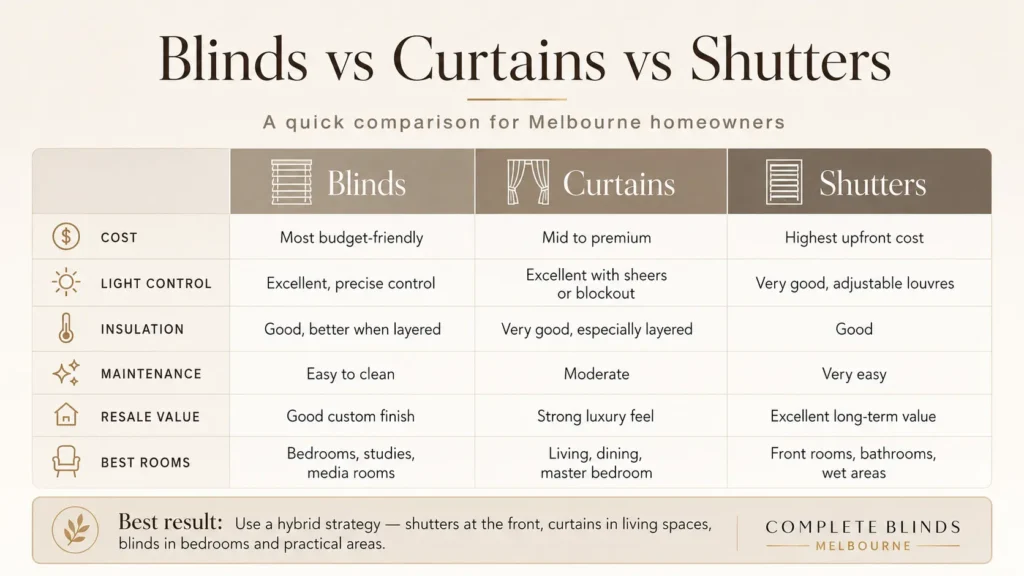
| Category | Blinds | Curtains | Shutters |
|---|---|---|---|
| Relative Price | Usually the most cost-effective option, especially roller blinds. Best for multi-room projects and budget control. | Mid to high range, depending on fabric, lining, track type, fullness, and installation size. | Usually the highest upfront cost, especially for custom-shaped windows or premium materials. |
| Thermal Insulation | Good with blockout or thermal-backed fabrics. Stronger when layered behind curtains. | Very strong when using lined blockout curtains or layered sheers and blockouts. Excellent for large glass areas. | Good for reducing direct sun and controlling airflow, though not always as thermally soft as layered fabric systems. |
| Light Control | Excellent. Rollers, Venetians, and Romans offer precise room-by-room control. | Excellent for diffusion and blockout, but less precise for angled control unless paired with blinds. | Strong angled light control through louvres, but not usually total blockout. |
| Acoustic Dampening | Limited, especially with flat roller fabrics. Roman blinds perform better than rollers due to fabric folds. | Strongest option. Fabric volume helps reduce echo in hard-surfaced modern homes. | Limited acoustic softness because shutters use hard materials. |
| Maintenance | Easy for roller blinds and many Venetians. Roman blinds require more care. | Moderate. Curtains need dust management and occasional professional cleaning depending on fabric. | Easy to maintain. Wipeable surfaces suit busy homes and wet areas. |
| Resale Value Add | Good when clean, custom-fitted, and consistent across the home. | Strong for luxury feel, especially in living areas and master bedrooms. | Very strong. Shutters can feel like permanent window furniture and improve kerb appeal. |
| Best Use | Bedrooms, studies, media rooms, apartments, new builds, and foundational privacy control. | Living rooms, dining rooms, master bedrooms, theatre rooms, and large glazing. | Street-facing rooms, bathrooms, bay windows, heritage homes, and high-value feature spaces. |
| Main Risk | Can look too basic if used alone in premium rooms. | Can become expensive and needs enough wall space for stacking. | Higher upfront cost and less softness than fabric options. |
The Hybrid Strategy: The Pro Secret
The most successful Melbourne homes rarely use one product everywhere.
They use a hybrid strategy.
This approach gives each room the window furnishing it needs based on function, exposure, privacy, moisture, and design importance.
A whole house fitted only with roller blinds can feel practical but flat. A whole house fitted only with curtains can become expensive and heavy. A whole house fitted only with shutters can feel rigid and may not suit every opening.
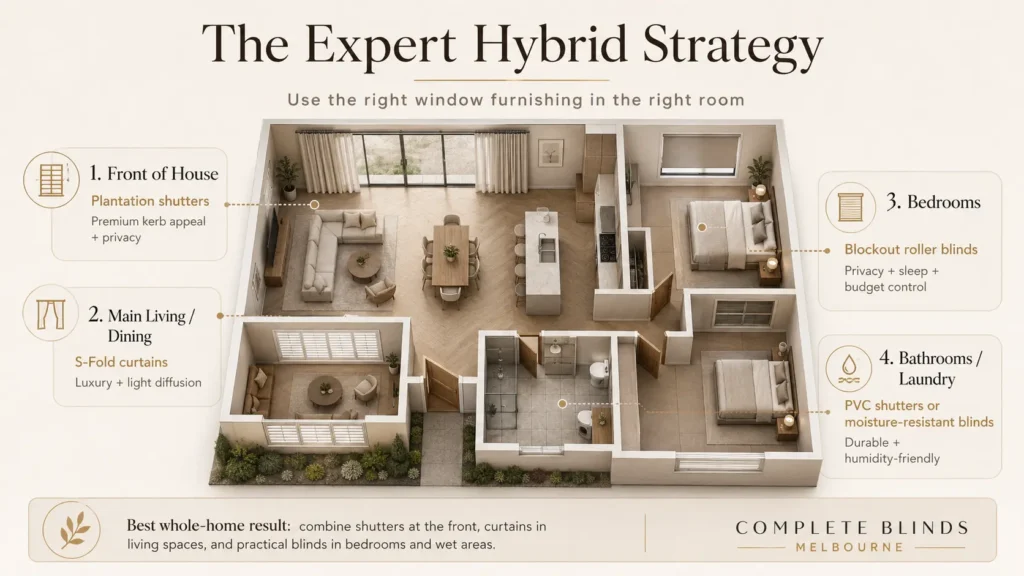
A hybrid plan solves this.
It gives you premium impact where people see and feel it most. It protects your budget in secondary areas. It also improves performance because each room receives the right product for its conditions.
Front of House: Shutters for Kerb Appeal
Street-facing rooms carry the most visual weight.
These windows affect how the home looks from outside. They also need privacy from footpaths, neighbours, and passing traffic.
Plantation shutters work beautifully in these spaces.
They add structure, symmetry, and kerb appeal. From inside, they allow you to angle the louvres for privacy without fully closing the room down.
Common front-of-house shutter locations include front bedrooms, formal lounges, bay windows, and period home facades.
For renovated Melbourne homes, shutters can also help connect older architectural details with a clean, updated interior.
Main Living and Dining: S-Fold Curtains for Luxury and Light Diffusion
The main living and dining zone usually needs softness, light diffusion, and scale.
This is where S-Fold curtains or sheers shine.
They soften large glass doors. They reduce glare. They make the room feel calmer and more finished. In open-plan spaces, they also help reduce echo from hard flooring, stone surfaces, and high ceilings.
Many homeowners pair sheer curtains with a hidden blockout layer or a roller blind behind them.
This gives the room daytime softness and night-time privacy.
For large sliding doors, ceiling-mounted S-Fold sheers can make the space feel taller and more architectural. They also help create the soft, premium look many Melbourne new builds now use.
Back Bedrooms and Wet Areas: Blinds and PVC Shutters for Control
Back bedrooms, children’s rooms, studies, laundries, and bathrooms often need practical choices.
This is where blinds and moisture-resistant shutters protect the budget and improve durability.
Blockout roller blinds work well in bedrooms because they offer privacy, darkness, and clean operation. They can also suit children’s rooms because they keep the design simple and easy to maintain.
For bathrooms and laundries, PVC shutters or suitable moisture-resistant options usually perform better than fabric curtains or Roman blinds. These spaces need materials that handle humidity, condensation, and regular cleaning.
A hybrid strategy does not lower the design quality.
It improves it.
Each room gets the window covering that suits the way the room works.
Beating Melbourne’s Climate
Melbourne weather creates unique challenges for window furnishings.
One week can bring a 40°C summer day. Another morning can feel cold enough to expose every draught in the house.
Windows are often the weak point.
Large glazing looks beautiful, but it allows heat gain in summer and heat loss in winter. Good window coverings help control that exchange.
Layering offers one of the best solutions.
A roller blind behind a sheer curtain can trap a layer of still air between the glass and the room. This layer helps slow heat movement. It works in a similar practical direction to double glazing, although it does not replace the performance of actual double-glazed units.
This layering also improves flexibility.
During the day, the sheer curtain can diffuse sunlight and reduce glare while keeping the room bright. At night, the roller blind can close for privacy and stronger insulation.
This is where the curtains vs blinds insulation question needs a practical answer.
Curtains generally provide better insulation than a single roller blind because they use more fabric and create more coverage. However, a layered blind-and-curtain system often performs better than either one used alone.
Shutters also help manage Melbourne’s climate.
They allow you to angle light away from the room during hot periods while maintaining airflow and privacy. In wet areas, they also avoid the moisture problems that fabric products can face.
For west-facing rooms, consider stronger blockout materials, layered curtains, or external shading where appropriate.
For south-facing rooms, focus on insulation and warmth.
For east-facing bedrooms, plan for early morning light control.
For north-facing living spaces, use flexible solutions that manage summer sun while still allowing winter light.
This is why custom advice matters. The best window furnishings Melbourne homeowners can choose are not based on trend alone. They depend on orientation, glazing size, room use, and the level of comfort required.
Motorisation and Modern Living
Automation has become a major part of window furnishing planning, especially in new builds and large renovations.
High windows, wide sliding doors, and multi-blind rooms benefit from motorisation because manual operation can become inconvenient over time.
Motorised blinds suit bedrooms, living areas, home theatres, and hard-to-reach windows. They can connect with remotes, wall switches, timers, apps, and smart home systems.
Roller blinds adapt particularly well to motors because the tube system creates smooth movement. This makes them ideal for daily routines such as morning opening, evening privacy, and heat control during peak sun.
Curtains can also be motorised, especially on large tracks. This creates a premium result in main living areas and master bedrooms.
Shutters operate differently. They can include mechanical tilt options, but they do not offer the same simple motorised open-and-close function as roller blinds or curtains.
For new builds, the key is early planning.
If you want automation, discuss power, control systems, wall switch locations, and smart home integration before plastering and electrical fit-off. Retrofitting can still work, but early planning gives a cleaner result.
Cost of Shutters vs Blinds and Curtains
The cost of shutters vs blinds depends on the window size, material, installation complexity, and number of openings.
In general, roller blinds sit at the most affordable end. They give strong function at a controlled price. This makes them ideal for bedrooms, investment properties, apartments, and full-home coverage.
Curtains vary widely.
A basic curtain may sit in the mid-range. A full-height S-Fold sheer with quality fabric, lining, and ceiling-mounted tracks can sit higher. The price increases with fullness, fabric quality, lining, and track length.
Shutters usually cost more upfront.
They require custom frames, panels, louvres, hardware, and careful installation. However, they can offer strong long-term value because they last well and contribute to the home’s permanent finish.
A smart budget does not treat every window equally.
Invest more in street-facing rooms, main living spaces, and the master bedroom. Use practical blinds in secondary bedrooms, studies, and utility rooms. Choose moisture-resistant solutions where the room demands durability.
This approach gives you a better whole-home result than spreading the budget evenly across every window.
Why Ringwood Factory-Direct Advice Matters
Complete Blinds supplies and manufactures blinds, curtains, and shutters from our Ringwood facility.
That matters because unbiased advice only works when a company can genuinely offer all three options.
If a supplier mainly sells blinds, they may recommend blinds for every room. If they mainly sell curtains, they may push fabric solutions even where moisture or budget makes that risky.
Our team can compare the full range.
We can assess whether a window needs roller blinds, curtains, shutters, or a combination. We can also manage custom window treatments Ringwood homeowners, builders, and renovators need for unusual windows, large glazing, angled rooms, and whole-home projects.
Factory-direct customisation also improves fit.
Custom blinds can reduce light gaps. Custom curtains can achieve the right fullness and drop. Custom shutters can align properly with frames, architraves, and window proportions.
Off-the-shelf products rarely deliver that level of finish.
A window furnishing should not look like an afterthought. It should feel planned from the start.
FAQs: Blinds vs Curtains vs Shutters
Blinds are usually the cheapest option, especially roller blinds.
They use less material, need simpler hardware, and suit multi-window projects. Curtains usually cost more because they require more fabric and track hardware. Shutters generally cost the most upfront because they use custom frames, panels, and detailed installation.
Moisture-resistant shutters usually work best in humid bathrooms.
PVC shutters or suitable moisture-resistant materials handle steam, condensation, and cleaning better than fabric curtains or Roman blinds. Some roller blinds can work in bathrooms if the fabric suits wet-area conditions, but fabric-heavy products need caution.
Yes. This is one of the best strategies for Melbourne homes.
A roller blind can provide privacy, blockout, and glare control. A sheer or curtain can add softness, light diffusion, and insulation. This layered system works especially well in living rooms, bedrooms, and large sliding doors.
No. Plantation shutters do not usually block 100% of the light.
They reduce light well and allow excellent privacy control, but small gaps can remain around louvres, frames, and panel edges. For bedrooms that need maximum darkness, blockout roller blinds or lined curtains may perform better.
Layered curtains and blinds usually provide the strongest insulation.
A lined blockout curtain can help reduce heat loss, especially when fitted generously and close to the wall or ceiling. A roller blind behind a curtain can improve performance further by trapping a still layer of air near the glass.
Shutters also help, especially by reducing draught movement and managing airflow.
No. Curtains are one of the strongest design features in modern new builds.
S-Fold sheers and ceiling-mounted curtain tracks have become common in high-end Melbourne homes because they soften large glazing, improve acoustics, diffuse light, and add luxury without visual clutter.
The key is choosing modern fabrics, correct fullness, and the right track position.
Final Expert Recommendation
The best answer to blinds vs curtains vs shutters is rarely one product.
Blinds give you function, budget control, and precise light management.
Curtains add softness, acoustic comfort, insulation, and luxury.
Shutters provide durability, kerb appeal, moisture resistance, and long-term value.
A strong Melbourne window furnishing plan uses each product where it performs best.
Use shutters at the front of the home where street appeal and privacy matter. Use S-Fold curtains or sheers in the main living zones where softness and scale matter. Use blockout roller blinds in bedrooms, studies, and practical spaces where privacy, darkness, and budget control matter.
For wet areas, use moisture-resistant shutters or suitable roller blind fabrics instead of heavy textiles.
With factory-direct production and expert advice from Complete Blinds in Ringwood, you can design a whole-home solution that balances budget, style, insulation, privacy, and long-term performance without being pushed into one product category.


