


Quick Verdict: Standard blockout roller blinds leave a mandatory 15–20mm side gap for operating brackets, creating an “edge halo” light bleed. To achieve true 100% pitch-black conditions, you need an enclosed system with a top cassette headbox, brush-lined side channels and a bottom sealing rail, custom-built to eliminate every millimetre of light intrusion.
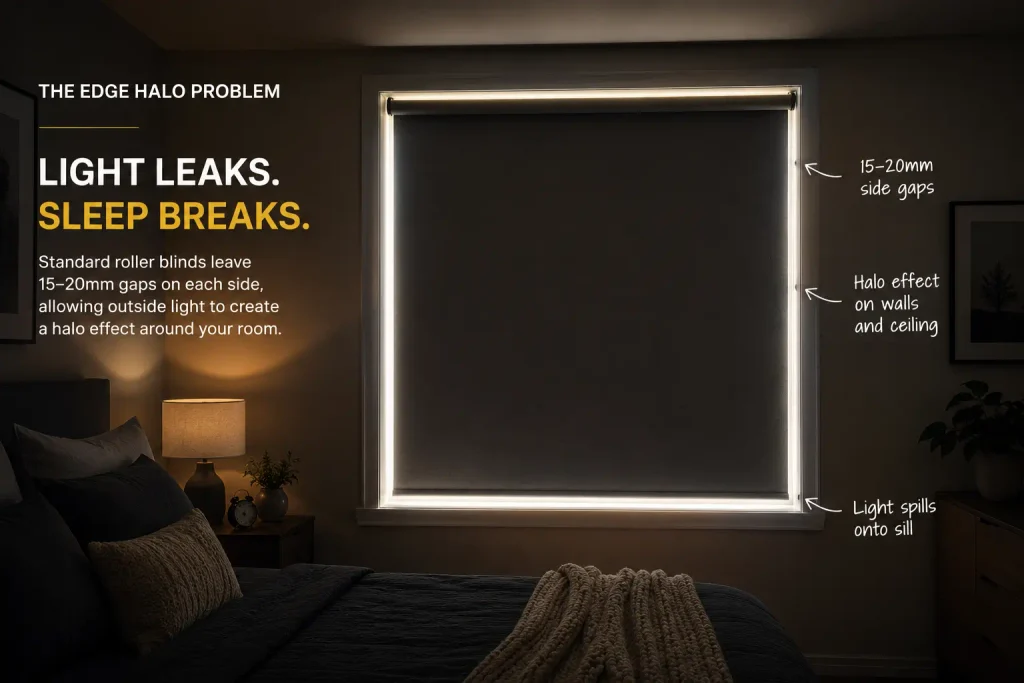
A dark fabric does not automatically create a dark room.
Many Melbourne homeowners discover this after installing standard roller blinds in a bedroom, nursery or media room. The fabric blocks the light passing through it, yet a bright glow still appears around the edges. Sunlight runs down both sides. Streetlights flare across the ceiling. Early morning light reflects off the window reveal and cuts straight into the room.
That glow has a name in the trade: the edge halo effect.
It is one of the most common problems with standard roller blinds. More importantly, it is not usually a fabric problem. It is an engineering limitation.
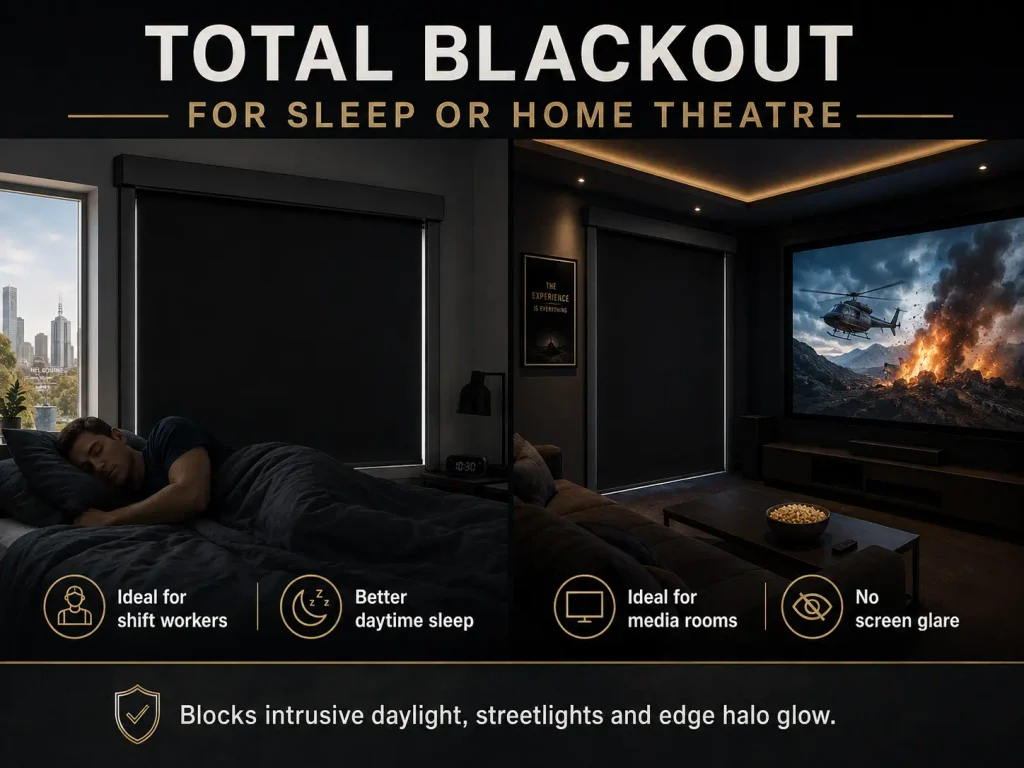
For shift workers, parents of newborns, home cinema owners and people living near bright streetlights, that small edge gap can feel enormous. A bedroom that should feel dark at 2pm still looks washed with light. A toddler wakes at sunrise. A projector loses contrast. A nurse finishing a night shift cannot get deep sleep because daylight keeps bouncing around the window frame.
This is where cassette roller blinds with side channels Melbourne homeowners choose become a specialist solution, not just an upgrade.
A cassette side-channel system does not only block light through the blind. It blocks light around the blind.
The “Edge Halo” Dilemma: Why Standard Blockout Blinds Leave You in the Light
Standard blockout roller blinds use opaque fabric designed to stop light from passing through the material.
That part works well.
The issue sits around the fabric. Roller blind fabric needs to sit between operating brackets. Those brackets hold the tube, chain control or motor, and end mechanisms. Because the fabric cannot run hard against the window reveal, manufacturers must allow a side deduction.
In practical terms, this often creates a 15mm–20mm light gap on each side.
During the day, sunlight enters through that gap and reflects off the window jambs. At night, streetlights, car headlights and neighbouring balcony lights can create the same effect. The light does not need a large opening. It only needs a slim vertical channel beside the blind.
That reflected glow spreads across walls, ceilings and furniture.
This is the edge halo effect.
It is especially noticeable in rooms with white window reveals, glossy paint, light-coloured walls or deep window frames. Even if the roller fabric itself is 100% blockout, the room can still feel far from black.
This is why homeowners need to understand the difference between two very different claims:
- 100% blockout fabric stops light passing through the material.
- 100% total blackout system stops light passing through and around the blind.
A standard roller blind can use excellent blockout fabric and still leak light at the perimeter.
A cassette system with side channels solves the perimeter problem.
Cassette Roller Blinds with Side Channels Melbourne: The Total Blackout Principle
The strongest blackout systems work like a controlled enclosure.
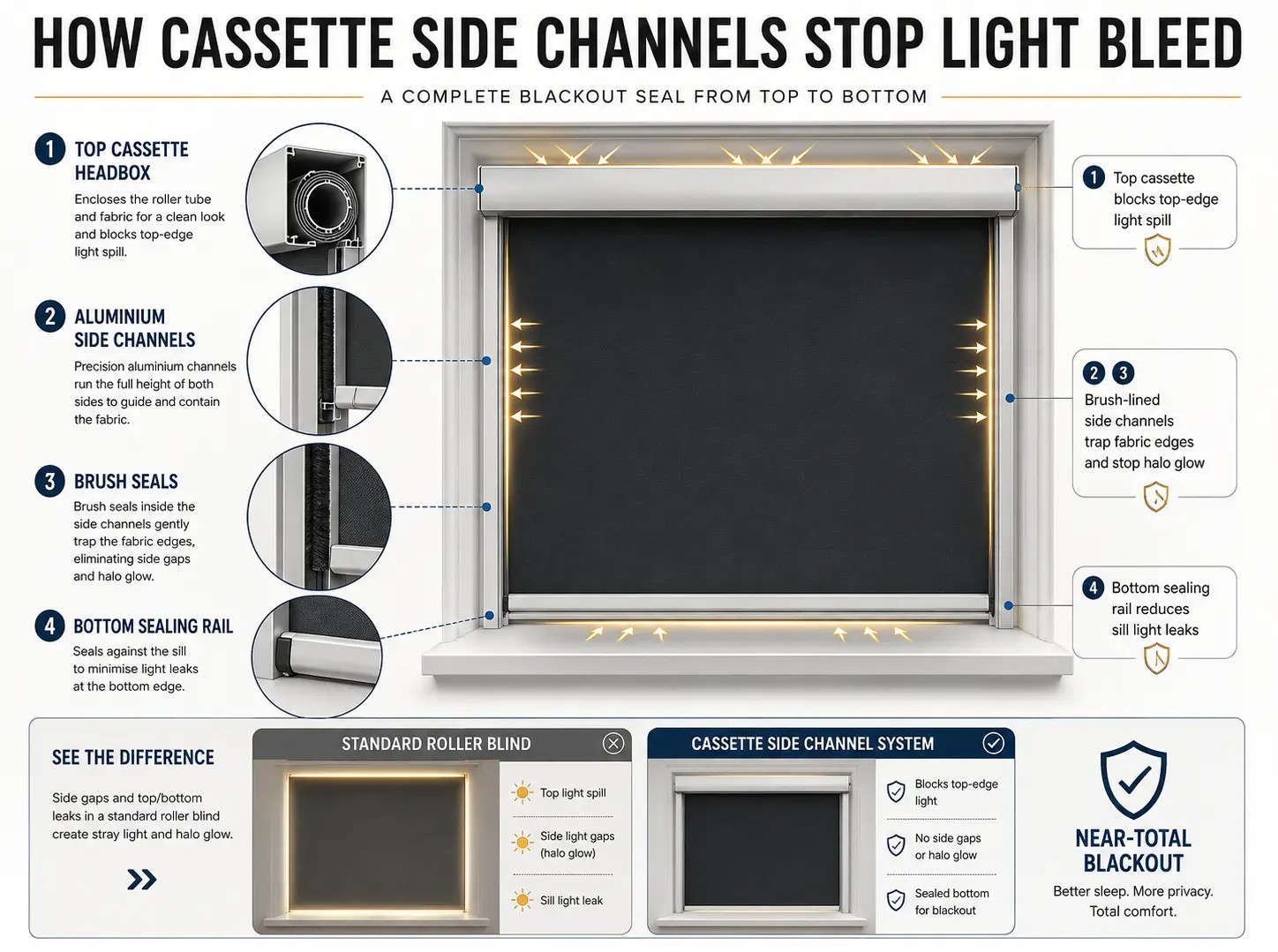
Instead of leaving the roller tube exposed and the fabric edges open, a cassette system traps the blind inside a frame. The headbox covers the top. The side channels hold the fabric edges. The bottom rail seals the lower edge.
Together, these components stop light from escaping through the usual weak points.
This is why cassette blackout roller blinds Ringwood homeowners request are usually custom-made rather than bought as a generic kit. Every window opening behaves differently. The frame may not sit square. The sill may slope. The architrave may twist. New builds can settle slightly. Older homes can vary from one side of the reveal to the other.
A total blackout blind only works if the system fits the actual opening.
Complete Blinds custom fabricates cassette and side-channel systems through our Ringwood factory. Our team measures, cuts and tests the system so the fabric stays locked into the tracks without bunching, rippling or jamming.
That precision matters because total blackout depends on millimetres.
The Anatomy of a Total Blackout Cassette System
A proper blackout cassette system has three core parts.
Each part controls a different light leak.
1. The Top Cassette Headbox
The top cassette headbox encloses the roller tube.
On a standard roller blind, light can spill over the top of the fabric, especially if the blind sits below the top of the reveal or projects forward from the glass. Dust also settles on the roller tube, brackets and fabric roll.
A cassette headbox solves both problems.
It hides the tube inside an enclosed aluminium housing. This creates a cleaner finish and blocks top-edge light spill. It also protects the fabric roll from dust, insects and general room debris.
For bedrooms and media rooms, the headbox becomes essential.
Without it, even a well-fitted side gap can still leave a bright horizontal line across the top of the window.
2. Side Channels with Brush Pile
Side channels are the vertical tracks that run down both sides of the blind.
They usually use extruded aluminium sections fitted to the reveal or face of the opening. The fabric edges travel inside the channels instead of floating freely beside the window.
High-density brush pile or light-blocking seals sit inside the channels.
These seals perform two jobs. First, they absorb light bounce. Second, they help guide the fabric while reducing movement.
This is the key difference between standard roller blinds and cassette side-channel systems.
The side of the fabric no longer sits near an open gap. It is captured inside the channel. As a result, sunlight, streetlight and headlight glare cannot run down the jamb.
For people searching for stop light bleed around roller blinds, side channels are usually the missing component.
3. Bottom Sealing Rail
The bottom edge of the blind also needs control.
A standard roller blind uses a base rail, but it may not seal tightly against the sill. If the sill slopes, the floor line varies, or the blind stops slightly above the frame, light can leak through the bottom.
A total blackout cassette system uses a heavier-duty bottom rail.
This rail can include a rubber gasket or brush seal designed to close the lower gap. When the blind lowers fully, the seal helps meet the sill or lower frame cleanly.
This matters most in nurseries, shift-worker bedrooms and theatre rooms, where even a small bottom glow can affect darkness.
A complete blackout system controls all four edges: top, left, right and bottom.
Who Needs Total Blackout?
Not every room needs a full cassette side-channel system.
For many living areas, a standard blockout roller blind or curtain layer provides enough privacy and glare control. However, some rooms need more than “dark enough”.
They need controlled darkness.
Night Shift Workers and First Responders
Healthcare workers, emergency staff, warehouse workers, transport operators and hospitality workers often sleep when the rest of the city is awake.
A nurse coming home at 8am may need to sleep through bright morning light. A paramedic finishing a night shift may need rest during peak summer daylight. A security worker may sleep at 2pm when sunlight is strongest.
For these users, total blackout blinds for shift workers are not a luxury.
They support recovery, health and routine.
Light exposure affects circadian rhythm. Even narrow light leaks can signal wakefulness to the body. A cassette system helps create the darkness needed for deeper daytime sleep.
Nurseries and Toddler Bedrooms
Parents often underestimate how much light affects baby and toddler sleep.
During daylight savings, Melbourne mornings can become bright very early. Afternoon naps can also become difficult when sunlight leaks around the blind and brightens the ceiling.
Nursery blackout window coverings Melbourne parents choose should control both direct light and edge light.
A cassette roller blind with side channels can help create a more consistent sleep environment. It supports nap routines, early bedtimes and better room control across the seasons.
Safety also matters in nurseries.
Motorised or chain-free operation can reduce loose chain risks, while a neat cassette system keeps the window area cleaner and more controlled.
Home Theatres and Media Rooms
Screen performance depends on light control.
OLED televisions, projectors and large media screens all lose visual impact when light reflects across the room. Even a thin edge glow can reduce contrast, wash out dark scenes and create visible glare on the screen.
A media room needs more than privacy.
It needs controlled darkness.
Cassette side-channel systems suit home theatres because they seal the perimeter and remove the halo effect. This allows the room to perform properly during daytime viewing as well as night use.
For serious AV setups, the blind should be planned with wall colour, screen position and light direction.
Urban High-Density Living
Townhouses, apartments and infill developments across Melbourne often sit close to external light sources.
Streetlights. Driveway lights. Car headlights. Balcony lighting. Security sensors. Neighbouring windows.
These light sources can shine directly into bedrooms and living spaces, especially in dense suburbs where windows face laneways, shared driveways or adjoining buildings.
A standard blind may reduce brightness but still allow side flare.
Cassette systems help block intrusion at the frame, making them valuable for high-density living.
Recess Fit vs Face Fit for Cassette Systems
The mounting position affects blackout performance.
A recess fit places the blind inside the window reveal. This can look clean and architectural because the system sits within the window opening. However, the reveal must be deep enough and reasonably square.
If the reveal twists, narrows or sits out of level, a recess-fit side channel may become difficult to operate.
A face fit places the system outside the opening, usually over the architrave or wall area around the window. This allows wider coverage and can improve blackout performance when the reveal is shallow or uneven.
Face fitting can also cover more of the frame.
For rooms with severe edge light, face fit may outperform recess fit because it moves the sealing system beyond the problem area.
Homeowners comparing installation styles should review our guide to outside mount roller blinds for wider frame coverage and stronger light control.
In some homes, the best solution combines a cassette system with curtains.
A side-channel cassette blind handles the technical blackout. Floor-to-ceiling modern curtains in Melbourne then add softness, acoustic damping and a hotel-suite finish.
This combination works beautifully in master bedrooms, nurseries and media rooms.
The cassette does the engineering. The curtain completes the interior.
Automation and Smooth Operation
Side channels improve blackout performance, but they also add friction.
The fabric edges run inside tracks, which means the system needs careful tension, alignment and operation. If someone pulls a manual chain aggressively or unevenly, the fabric can twist, rub or track poorly.
This is where motorised blinds become a smart upgrade.
A quality motor drives the blind smoothly from the tube. Systems such as Somfy® or Automate® can raise and lower the blind with consistent speed and controlled stopping points.
That smooth movement matters in side-channel systems.
It reduces the risk of fabric skewing. It prevents hard pulling. It also makes daily use easier for large bedroom windows, media rooms or hard-to-reach openings.
Motorisation also supports routine.
Shift workers can lower the blind from bed. Parents can adjust a nursery without disturbing a child. Home theatre owners can close multiple blinds at once before starting a movie.
Timers and smart-home control add another layer.
A blind can close automatically before afternoon sun hits the room. It can open gradually in the morning. It can connect to scenes for sleep, cinema or privacy.
For blackout rooms, automation is not only about convenience. It also protects the system from rough manual operation.
The Ringwood Custom-Fit Benchmark
Off-the-shelf channel kits often fail because windows are rarely perfect.
A side channel system needs parallel, plumb and correctly spaced tracks. If the opening is out of square, the fabric may bunch on one side, ripple under tension or jam inside the channel.
Older Melbourne homes often have this issue.
Timber frames move over time. Plaster lines vary. Sills slope. Architraves sit unevenly. Meanwhile, new builds can also shift slightly as materials settle, especially around larger openings.
A generic kit cannot account for those site conditions.
Complete Blinds handles this through precision measuring and custom fabrication at our Ringwood factory.
Our team custom-cuts extruded aluminium side channels to suit the actual window dimensions. We assess the reveal, the mounting surface, the sill and the best fixing position before manufacturing the system.
Powder-coating also matters.
A blackout system should not look like an industrial afterthought. Aluminium cassettes and side channels can be finished to suit popular Melbourne interior and window-frame colours, including Monument®, Surfmist®, Black and anodised-style finishes.
Matching the frame colour helps the system blend with aluminium windows, plaster details or interior hardware.
Before installation, the system needs the right balance of fabric tension and track clearance.
Too loose, and light or movement becomes a problem. Too tight, and the blind may jam. A custom-built system allows that balance to be controlled properly.
For customers searching cassette blackout roller blinds Ringwood, this local manufacturing process is the difference between a blind that merely looks dark and one engineered for blackout performance.
100 Blockout Blinds Light Channels: What the Phrase Really Means
Many homeowners search for 100 blockout blinds light channels because they want a simple answer: “Can I make this room completely dark?”
The practical answer depends on the system.
A normal blockout roller blind uses blackout fabric, but it still leaks light around the sides. A cassette roller blind with side channels uses blackout fabric plus a perimeter control system.
That is the difference.
The fabric blocks the centre. The headbox blocks the top. The side channels block the vertical edges. The bottom rail blocks the sill gap.
For true blackout, each part needs to work together.
If one edge remains open, the halo effect can return.
This is why product selection and installation detail matter more than fabric name alone. A poor installation can undermine an excellent blackout fabric. A well-built cassette system can dramatically improve the result.
Cassette Roller Blinds with Side Channels Melbourne: Best Rooms to Prioritise
A full blackout system costs more than a standard roller blind, so many homeowners choose it selectively.
Start with the rooms where light control affects lifestyle most.
For shift workers, the main bedroom usually comes first. If a partner sleeps normal hours, consider motorisation so the room can adapt quickly.
For families, nurseries and toddler rooms offer the strongest benefit. Consistent darkness can support sleep routines and reduce early waking.
For media lovers, the theatre room or TV room should take priority. The improvement in screen contrast can be immediate.
For urban homes, prioritise windows facing streetlights, shared driveways or neighbouring balconies.
Not every window needs a side-channel cassette. However, the right window absolutely does.
Frequently Asked Questions
A blockout roller blind stops light passing through the fabric. A cassette side-channel blind also blocks light around the fabric by sealing the top, sides and bottom.
Yes. They can often be retrofitted to existing windows, provided there is enough space for the cassette and tracks. Custom measuring is essential.
They can add friction because the fabric runs inside tracks. Motorisation usually gives smoother operation and reduces pulling, twisting and fabric misalignment.
They may slightly soften outside noise by sealing gaps and adding fabric, but they are primarily designed for light control. For stronger acoustic comfort, layer them with heavy curtains.
Common options include Black, Monument®, Surfmist®, white and anodised-style finishes. Custom powder-coating may also be available depending on the project.
A correctly measured and installed cassette system with side channels, brush seals and a bottom rail can create near pitch-black conditions, even in strong daylight. Site conditions still matter.
Final Recommendation
For Melbourne homes with serious light leakage, standard roller blinds often cannot solve the problem alone.
The issue is not the fabric. It is the open perimeter.
A normal blockout blind leaves side gaps for brackets and operation. Those gaps create the edge halo effect, allowing sunlight, streetlights and reflected glare to spread around the room.
Cassette roller blinds with side channels Melbourne homeowners choose solve this by enclosing the blind system.
The cassette controls top light spill. The side channels capture the fabric edges. The brush seals absorb bounce. The bottom rail closes the sill gap.
For shift workers, this can support daytime sleep. For nurseries, it can help protect nap routines. For home theatres, it can preserve screen contrast. For urban homes, it can block intrusive night lighting.
The key is custom fit.
Melbourne windows vary too much for generic side-channel kits to perform reliably. Reveals can sit out of square. Sills can slope. Frames can move. Even new builds can settle.
Complete Blinds manufactures from our Ringwood factory, custom-cutting aluminium channels, matching powder-coated finishes and testing fit so the fabric tracks smoothly without jamming.
If you want total blackout, do not stop at blockout fabric.
Control the whole opening.
That is how you eliminate the edge halo effect properly.
Need a Truly Dark Room? Get a Custom Blackout Solution Made in Ringwood
If standard blockout blinds are still letting light leak around the edges, the problem is not your fabric — it is the fit.
Complete Blinds can custom-measure and manufacture cassette roller blinds with side channels from our Ringwood factory, helping reduce side light bleed, top-edge glow and streetlight intrusion.
Whether you need better daytime sleep, a darker nursery, a proper home theatre or relief from harsh urban lighting, our team can recommend the right cassette, track, fabric and control system for your windows.
Book a free measure and quote with Complete Blinds Melbourne and get a blackout solution built to suit your exact room.


