


Quick Verdict: Commercial and Class 2–9 multi-residential builds in Victoria mandate strict window furnishing compliance. Internal commercial roller blinds and curtains must meet AS/NZS 1530.2/1530.3 fire retardant standards, evaluating ignitability, flame spread, heat evolved, and smoke development. External shading also contributes to NCC 2022 Section J energy efficiency targets. Certified factory-direct window furnishings support smoother sign-off by building certifiers.
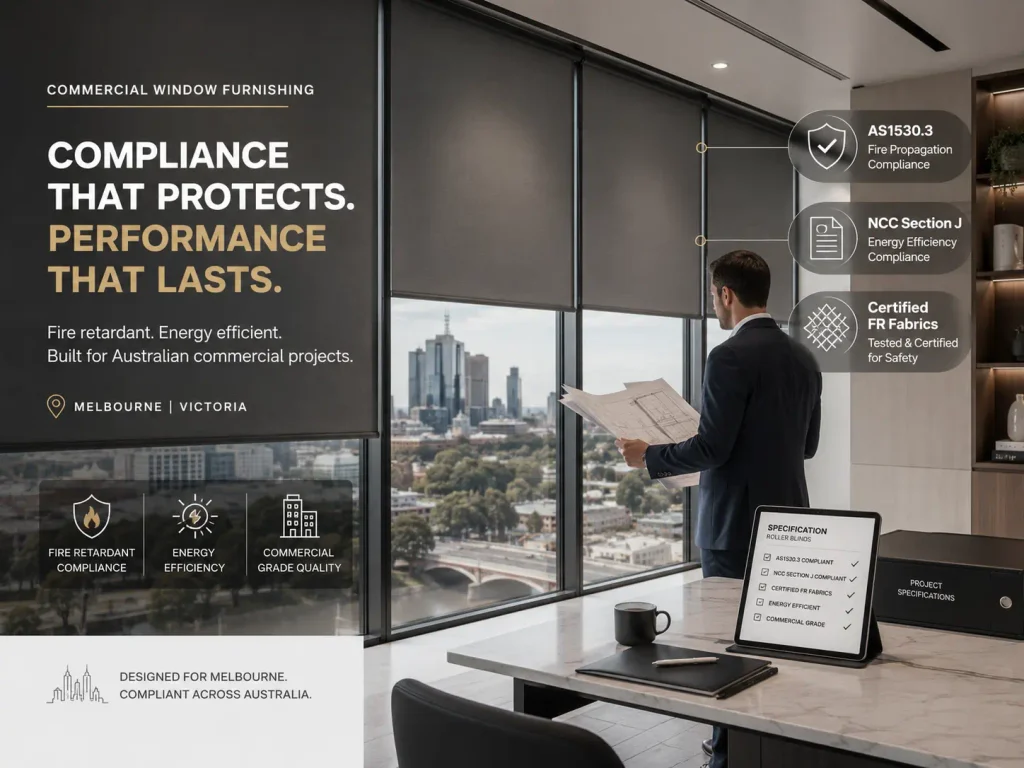
Commercial blinds in Melbourne fire retardant projects are not selected the same way as domestic blinds.
In residential work, the conversation often starts with colour, privacy, glare, or room styling. In commercial and multi-residential work, the first questions are different.
Does the fabric meet the specification?
Can the supplier provide AS1530 test documentation?
Will the product satisfy the building surveyor, fire engineer, superintendent, or facility manager?
Can it be manufactured at volume, delivered on programme, and installed safely across multiple levels?
For Class 2–9 buildings in Victoria, window furnishings sit inside a broader compliance environment. Fire safety, energy efficiency, durability, acoustic comfort, child safety, accessibility, and tender documentation can all affect the final specification.
A blind that looks acceptable in a display home may fail a commercial tender because it has no fire certificate. A curtain fabric that suits a boutique interior may be rejected because the Smoke Developed Index is too high. A manually chained blind may create child safety or operational concerns in multi-residential, education, aged care, or healthcare projects.
Complete Blinds supports commercial builders, architects, body corporates, and fit-out contractors from our Ringwood facility. Our team can assist with specification, certified FR fabric test sheets, bulk manufacturing, project staging, and commercial installation across Greater Melbourne.
That local supply capability matters when the programme is tight and the certifier needs documentation before practical completion.
Navigating Commercial Building Classes in Victoria
The National Construction Code separates buildings into classes because each use carries different risks.
For commercial and multi-residential window furnishings Victoria projects, the class of building influences fire expectations, durability requirements, operating systems, safety controls, and documentation.
Class 2: Multi-Residential Apartment Complexes
Class 2 buildings include apartment buildings with two or more sole-occupancy units.
Window furnishing specifications in Class 2 projects often need consistency across the external facade, especially where blinds face balconies, street elevations, or common areas. Developers also need products that can handle bulk installation, repeated operation, tenant turnover, and long-term maintenance.
Fire retardant roller blind fabrics are commonly specified because they provide a clean appearance, reliable operation, and consistent facade presentation.
Child safety also matters in apartments, particularly where corded internal blinds are installed in dwellings, serviced apartments, or build-to-rent projects.
Class 3 and Class 9: Accommodation, Healthcare, Schools, and Aged Care
Class 3 buildings can include hotels, motels, boarding houses, hostels, and similar accommodation.
Class 9 buildings include public-use buildings such as healthcare facilities, schools, assembly buildings, and aged care environments, depending on subclass.
These projects usually apply stricter scrutiny to flame spread, smoke development, hygiene, fabric durability, and safe operation. In healthcare and aged care settings, fabrics may also need antimicrobial, anti-fungal, easy-clean, or wipeable properties.
For these environments, domestic blinds rarely provide enough supporting documentation.
Class 5 and Class 6: Offices and Retail
Class 5 buildings include commercial office spaces. Class 6 buildings include retail premises and shopping centres.
In these projects, blinds must control glare, heat, privacy, and appearance without creating compliance risk. Large glazing areas often drive both thermal and visual comfort requirements.
Office roller blinds bulk Melbourne projects also need strong supply consistency. Colour variation, inconsistent tube sizes, mixed bracket types, and undocumented fabric substitutions can create defects at handover.
For commercial projects, standard domestic window coverings can fail because they lack:
- AS1530.2 or AS1530.3 fire test certificates
- Commercial-grade hardware
- Tender-compliant fabric schedules
- Consistent batch control
- Installation labels and cord safety components
- BMS or automation compatibility
- Documented warranty and maintenance support
A certifier may not reject a blind because it looks domestic. They may reject it because the documentation does not prove compliance.
Commercial Blinds Melbourne Fire Retardant: AS/NZS 1530.2 and AS/NZS 1530.3 Explained
Fire retardant performance sits at the centre of many commercial blind and curtain specifications.
Tender schedules often request AS1530 3 compliant blinds because building surveyors, architects, and fire engineers need evidence that internal fabrics will not contribute unacceptably to early fire growth, flame spread, heat release, or smoke.
AS/NZS 1530.2: Flammability of Thin Flexible Materials
AS/NZS 1530.2 relates to flammability testing for thin, flexible sheet or woven materials.
For window furnishings, this can apply to blind and curtain fabrics that behave as flexible textile products. The test helps assess how readily a material ignites and burns under controlled conditions.
In practical tender language, the relevant issue is simple: the supplier must be able to provide the correct test certificate for the exact fabric specified.
A similar-looking fabric is not good enough.
If the builder installs a substitute fabric without matching fire documentation, the project team may face delays during compliance review.
AS/NZS 1530.3: Early Fire Hazard Properties
AS/NZS 1530.3 assesses early fire hazard properties.
Commercial certifiers and consultants typically review four key indices:
- Ignitability Index: Scale 0–20
- Spread of Flame Index: Scale 0–10
- Heat Evolved Index: Scale 0–10
- Smoke Developed Index: Scale 0–10
A lower result generally indicates better fire hazard performance.
In many commercial specifications, the Spread of Flame Index receives close attention because it indicates how readily flame travels across the material surface. Smoke Developed Index also matters because smoke inhalation can create significant life safety risks in enclosed commercial, healthcare, education, hotel, and multi-residential environments.
Many tenders call for a Spread of Flame Index of 0 and a low Smoke Developed Index, particularly in higher-risk public or accommodation buildings.
Why Fire Retardant Fabric Construction Matters
High-performance commercial roller blinds often use inherently flame-retardant polyester, fibreglass-core yarns, or specialised screen fabrics.
Inherently FR fabrics usually perform more reliably than fabrics treated only after manufacture because their flame-retardant properties form part of the fibre or yarn structure. However, the correct answer depends on the fabric type, test report, cleaning method, and project specification.
Commercial builders should always request:
- Fabric name and colour
- AS1530.2 or AS1530.3 test certificate
- Test laboratory details
- Test date and report number
- Batch or range applicability
- Maintenance restrictions
- Warranty conditions
- Supplier confirmation for the installed product
For Complete Blinds commercial projects, our Ringwood team can assist with FR test sheets and fabric schedules before procurement. This helps reduce substitution issues during tender review and handover.
NCC Section J Commercial Shading and Energy Efficiency
NCC Section J commercial shading requirements sit within the wider energy efficiency provisions for commercial buildings.
For Class 3 and Class 5–9 projects, Section J focuses on reducing energy consumption through the building envelope, glazing, sealing, air-conditioning, ventilation, lighting, and services.
Windows can create major cooling loads in commercial buildings.
Large areas of glass bring daylight and architectural value, but they also increase glare, radiant heat, and air-conditioning demand. In Melbourne office towers, retail tenancies, schools, medical suites, and apartment common areas, unmanaged solar gain can quickly become a mechanical services problem.
Window furnishings help control that load.
Internal blinds manage glare and improve occupant comfort. External shading reduces solar heat before it enters through the glass. Automated systems improve consistency because they do not rely on occupants manually adjusting blinds throughout the day.
Motorised Window Coverings and BMS Integration
Automated motorised window coverings can connect with timers, sensors, remotes, wall switches, and Building Management Systems.
In commercial buildings, this matters because blinds can respond to sun position, facade orientation, tenancy hours, or cooling demand.
For example, west-facing blinds may close during peak afternoon heat. North-facing zones may adjust seasonally. Meeting rooms can switch quickly between presentation mode and daylight mode.
This supports:
- Reduced solar glare
- Lower cooling load pressure
- Improved occupant comfort
- Better screen visibility
- Reduced manual handling
- Cleaner facade consistency
For NCC Section J commercial shading strategies, the best results come from early coordination between the architect, energy consultant, mechanical engineer, electrical contractor, and window furnishing supplier.
Retrofitting automation after plaster, ceiling grids, or joinery are complete can create access problems and visible wiring.
External Awnings and SHGC Control
External awnings can improve solar control because they stop direct radiation before it reaches the glass.
Internal blinds manage heat after sunlight has already entered the building. External shading works earlier in the heat pathway, which can reduce the load on internal spaces more effectively.
For ground-floor commercial suites, hospitality areas, schools, childcare centres, apartment balconies, and retail frontages, awnings can also improve occupant comfort and usable outdoor space.
However, external shading must suit the building facade, wind exposure, fixing substrate, fire strategy, body corporate requirements, and planning controls.
That is why early specification matters.
Acoustic Control, Hygiene, and Durability in High-Traffic Commercial Spaces
Commercial window furnishings often need to do more than satisfy fire and energy requirements.
They must also survive heavy use.
A blind in a home may operate once or twice per day. A blind in a school, office, medical suite, hotel room, or aged care facility may operate far more often and by different users.
Hardware selection becomes critical.
Commercial projects often need:
- Heavy-duty chain mechanisms
- Commercial-grade spring or clutch systems
- Stronger aluminium tubes
- Anti-tamper components
- Replaceable brackets
- Robust base rails
- Motorised control for large openings
- Consistent fabric tension across multiple blinds
Acoustic Window Furnishings
Heavy commercial drapes, lined curtains, and some screen fabrics can improve acoustic comfort by reducing echo and reverberation.
Noise Reduction Coefficient, or NRC, may appear in specifications where acoustic consultants are involved. This is common in boardrooms, hotels, education spaces, healthcare waiting areas, theatres, and multi-purpose rooms.
Roller blinds offer limited acoustic absorption because the fabric sits flat. Drapery and heavier textile layers generally perform better because folds increase surface area and fabric depth.
Hygiene and Specialist Coatings
Healthcare, aged care, education, and hospitality projects may require easy-clean, anti-fungal, anti-bacterial, or moisture-resistant fabrics.
These requirements should be confirmed early.
A beautiful fabric that cannot tolerate the cleaning protocol may fail in use. Similarly, a fabric that meets fire requirements but lacks hygiene suitability may not suit a medical or aged care fit-out.
Plantation Shutters in Commercial Interiors
Custom plantation shutters can suit high-end multi-residential developments, boutique hotels, executive boardrooms, wellness spaces, and premium reception areas.
They provide a robust, low-maintenance aesthetic with strong light control and privacy.
Shutters may not suit every commercial application, especially where fire, fixing, access, or maintenance constraints dominate. However, in selected premium spaces, they create a clean architectural finish and reduce reliance on soft textiles.
Child Safety and Cord Compliance in Multi-Residential Window Furnishings Victoria
Child safety remains a serious compliance issue for internal blinds and curtains with cords or chains.
This is especially relevant in:
- Class 2 apartments
- Build-to-rent developments
- Hotels and serviced apartments
- Education settings
- Healthcare accommodation
- Aged care visitor rooms
- Mixed-use developments with residential components
Corded internal window coverings must be supplied and installed with compliant safety components, labelling, and installation practices.
Loose cords and chains can create strangulation hazards. Therefore, commercial suppliers and installers need to ensure tension devices, cleats, warning labels, installation labels, and cord lengths meet the mandatory safety requirements.
For project teams, this should not be left to the installer on the day.
It should appear in the specification and quality assurance process.
Motorisation can also help reduce cord risks in multi-residential and commercial settings. Where chains are removed entirely, the window furnishing system can become safer, cleaner, and easier to operate.
Commercial Specification Matrix: Compliance and Performance Comparison
| Commercial Application | Key Mandatory Standard / Requirement | Recommended Product & Fabric Spec | Primary Engineering / Fire Safety Benefit |
|---|---|---|---|
| Office Fit-Out | AS1530.3 fabric documentation, glare control, heavy-duty operation, Section J coordination | FR screen roller blinds, commercial clutch or motorised system, consistent fabric batch | Controls glare, supports cooling load management, provides certifier-ready documentation |
| Multi-Res Apartments | AS1530.3 where specified, child safety compliance, facade consistency | FR roller blinds, chain tensioners or motorised operation, matching external-facing colours | Supports handover consistency, safer operation, and reduced certifier risk |
| Aged Care / Healthcare | Low flame spread, low smoke, hygiene performance, easy operation | FR antimicrobial or easy-clean fabrics, motorised or wand-controlled systems | Reduces fire and hygiene risk while improving occupant usability |
| Schools and Education | FR fabric, child safety, durability, glare reduction | Commercial roller blinds, anti-tamper hardware, robust tubes and brackets | Improves classroom visual comfort and withstands high-frequency use |
| Hotels and Serviced Apartments | FR drapery or blinds, acoustic comfort, blockout performance | FR blockout curtains, FR sheers, motorised rollers, lined drapes | Provides guest comfort, darkness, acoustic softness, and fire documentation |
| Retail / Shopping Centres | Section J solar control, durability, facade presentation | FR screen blinds, external awnings where suitable, motorised control | Reduces solar heat gain and supports consistent shopfront presentation |
| Executive Boardrooms | Glare control, acoustic comfort, premium finish | Motorised FR screen blinds, acoustic drapes, custom shutters in selected spaces | Improves presentation visibility, privacy, and high-end interior finish |
| Common Areas | Fire safety, durability, ease of maintenance | FR roller blinds or external shading depending on facade exposure | Provides consistent light control with lower maintenance risk |
The Complete Blinds Commercial Advantage: Spec to Handover
Commercial projects need more than product supply.
They need coordination.
Complete Blinds supports projects from specification through to handover, helping builders and designers reduce risk across procurement, documentation, manufacturing, and installation.
1. Specification Assistance
Early involvement allows our team to review the project requirements before the blind schedule becomes locked in.
We can assist with:
- Fabric selection
- FR documentation
- Operation type
- Hardware suitability
- Facade consistency
- Colour matching
- Motorisation planning
- Large-window feasibility
- Installation access constraints
For commercial blinds Melbourne fire retardant projects, this early review helps prevent non-compliant fabric choices from reaching site.
2. FR Certificate Documentation
Commercial certifiers and building surveyors may request evidence that the installed product matches the specified fire-rated fabric.
Complete Blinds can provide FR test sheets for selected commercial fabrics and assist with documentation packs for handover.
This supports builders, project managers, and contract administrators who need clear records for defects, certification, and client sign-off.
3. Ringwood Factory Bulk Manufacturing
Our Ringwood facility allows Complete Blinds to manage volume production with local oversight.
This gives commercial clients better control over:
- Batch consistency
- Fabric cutting
- Tube sizing
- Hardware matching
- Lead times
- Quality checks
- Urgent replacement needs
- Staged delivery
Local manufacturing also reduces the risk of relying on generic imported sizes that do not suit Melbourne site conditions.
4. Commercial Installation Across Greater Melbourne
Commercial installation requires planning around programme, access, safety, tenancy fit-out staging, and site coordination.
Our team can work across:
- Office fit-outs
- Multi-residential developments
- Medical and allied health suites
- Retail tenancies
- Education buildings
- Apartment common areas
- Boutique accommodation
- Body corporate upgrade works
The goal is simple: compliant products, clean installation, accurate documentation, and fewer issues at handover.
Frequently Asked Questions
Most projects request AS/NZS 1530.3 test reports, and some may also require AS1530.2 flammability documentation. Provide the exact fabric name, colour range, test report, supplier confirmation, and any tender-specific compliance data.
Only if they meet the project specification and compliance requirements. Many domestic blinds lack FR certificates, commercial hardware, cord safety documentation, and batch consistency, so commercial-grade blinds are usually safer for Class 2 projects.
Automated blinds help control glare and solar heat gain by responding to sun exposure, timers, sensors, or BMS controls. This can reduce HVAC cooling pressure and support the building’s energy efficiency strategy.
It depends on the fabric. Inherently FR fabrics usually retain performance better because the FR property forms part of the fibre. Treated fabrics may require cleaning restrictions and maintenance checks. Always confirm with the supplier’s certificate.
Yes. Complete Blinds can support bulk commercial quoting, FR fabric documentation, product schedules, specification assistance, Ringwood-based manufacturing, and commercial installation across Greater Melbourne.
Final Compliance Recommendation
For commercial builders, architects, project managers, facility managers, and developers, window furnishings should be treated as a compliance item, not a late-stage decoration.
The safest approach is to specify early.
Select fabrics with the correct AS1530.2 or AS/NZS 1530.3 documentation. Confirm Section J solar control requirements with the energy consultant. Resolve child safety details before installation. Choose hardware that suits heavy commercial use. Keep records ready for the certifier.
Most importantly, source from a supplier that understands commercial project documentation.
Complete Blinds provides commercial window furnishing support from our Ringwood facility, including certified fire-retardant fabric test sheets, volume manufacturing, custom sizing, motorised options, external shading, and commercial installation across Greater Melbourne.
That factory-direct process helps reduce risk from tender stage to handover.
For commercial blinds Melbourne fire retardant projects, the right supplier does more than provide blinds.
They help the project get signed off.
Need Commercial Blinds Specified, Supplied or Installed?
Commercial window furnishings need more than the right colour and fabric. They need the correct fire-retardant documentation, suitable hardware, compliant installation, and clear records for builders, certifiers and project managers.
Complete Blinds can assist with commercial roller blinds, motorised window coverings, external shading, shutters and large-scale multi-residential window furnishing projects across Melbourne.
From our Ringwood facility, we support specification, bulk manufacturing, FR fabric documentation, custom sizing and commercial installation for offices, apartments, schools, healthcare spaces, retail fit-outs and body corporate projects.
If you need compliant window furnishings for an upcoming project, speak with our team and book a service enquiry today.


