


Recess fit, or inside mount, sits neatly inside the window reveal for a sleek, flush architectural look, but needs enough frame depth, typically 50mm–75mm, and naturally creates small side light gaps due to mechanism clearances. Face fit, or outside mount, attaches to the architrave or wall, extending past the window edge to block side light leakage and bypass handles or shallow reveals.
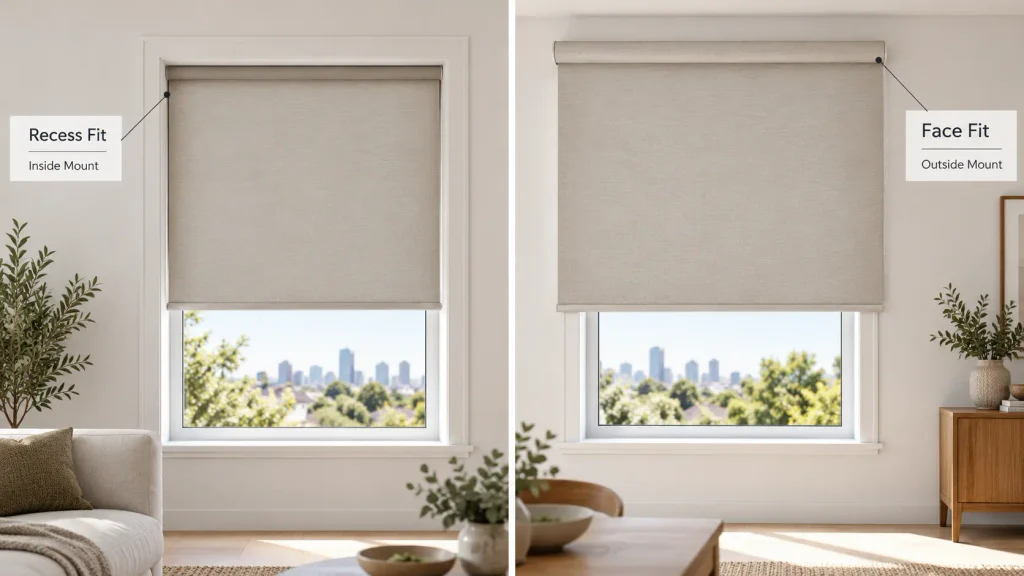
Choosing between recess fit vs face fit roller blinds is not only a styling decision.
It affects light control, privacy, insulation, handle clearance, fabric tracking, motorisation, installation strength and how clean the finished window looks. The wrong mounting choice can make a premium blind look awkward. It can also leave unwanted light gaps, scraping fabric, poor roll alignment or brackets that struggle to hold properly.
Melbourne homes make this decision even more technical.
A new townhouse in Box Hill may have square-set plaster reveals with limited depth. A renovated Ringwood home may have mixed timber architraves from different building stages. A Victorian terrace in Carlton or Hawthorn may have deep heritage timber frames that sit out of square after decades of movement. Apartments often use shallow aluminium frames with handles projecting into the reveal.
This is why Complete Blinds measures and manufactures custom roller blinds from our Ringwood factory hub. Our team checks the actual window, not just the visible opening. We measure top, middle and bottom widths, review handle obstructions, assess reveal depth, and deduct millimetres carefully so the blind runs smoothly without scraping jambs or binding.
A roller blind should not simply cover a window.
It should suit the architecture, operate cleanly and perform properly every day.
Demystifying the Mount Styles: Recess Fit vs Face Fit
The first decision is where the blind brackets will sit.
That bracket position determines how the fabric falls, how much light escapes around the blind, and whether the system looks hidden or framed.
What Is Recess Fit, or Inside Mount?
A recess fit roller blind mounts inside the window reveal.
The brackets fix into the side, top or inner face of the frame opening. The blind sits within the window depth rather than projecting over the wall or architrave.
This creates a clean architectural finish.
From the room, the blind feels integrated into the window. It does not cover the surrounding trim. It allows architraves, decorative timber frames or modern square-set plaster lines to remain visible.
Recess fit suits:
- Minimalist interiors
- Square-set plaster reveals
- Deep timber windows
- Living rooms where full blackout is not essential
- Windows with enough internal depth
- Spaces where clean alignment matters more than full edge coverage
The limitation is clearance.
A recess blind must fit inside the opening, which means the product has to work around reveal depth, handles, locks, winders, uneven frames and bracket deductions.
What Is Face Fit, or Outside Mount?
A face fit roller blind mounts outside the reveal.
The brackets attach to the architrave, wall stud, head plate or ceiling above the window. Instead of sitting inside the opening, the blind covers the window from the front.
This gives stronger coverage.
The fabric can extend past the glass and frame, reducing side light leakage and increasing privacy. It also avoids many handle problems because the blind sits in front of the obstruction rather than inside the reveal.
Face fit suits:
- Bedrooms
- Nurseries
- Media rooms
- Shallow reveals
- Sliding doors
- Windows with projecting handles
- Uneven or out-of-square reveals
- Rooms needing stronger light control
The visual effect is different.
A recess fit blind disappears into the opening. A face fit blind frames the window more boldly.
Neither style is automatically better. The correct choice depends on depth, function, light control and the home’s interior style.
The Window Frame Depth Rule: The 50mm–75mm Benchmark
Reveal depth is the first technical filter.
Before choosing fabric, colour or chain side, you need to know whether the blind physically fits inside the window opening.
For many roller blinds, a practical minimum recess depth sits around 50mm–75mm, depending on blind size, bracket type, fabric thickness, tube diameter and whether the roll is standard or reverse.
This is a benchmark, not a universal rule.
A small bathroom blind with light fabric may need less space than a wide bedroom blind using heavy blockout fabric. Dual rollers need more depth again. Motorised blinds may need additional room at the control end, especially where battery motors or larger brackets are used.
Why Roll Diameter Matters
A roller blind is not flat once it is raised.
The fabric wraps around a tube, creating a roll. The longer the drop and the thicker the fabric, the larger that roll becomes.
A small kitchen blind may create a compact roll. A tall sliding door blind in blockout fabric may build a much larger roll that projects forward.
If the reveal depth is too shallow, the roll may protrude beyond the frame, hit handles, scrape the glass, or look awkward from the side.
This is why frame depth for roller blinds should be checked before confirming a recess fit.
Handles, Winders and Locks
Window hardware can make recess mounting difficult.
Common obstructions include:
- Winder handles
- Push-locks
- Sliding door handles
- Awning window chains
- Flyscreen frames
- Security screen frames
- Timber stops
- Tiled reveals in wet areas
Even if the reveal looks deep enough, the blind may still fail if a handle projects into the fabric path.
This is where a professional installer checks how the blind will move, not just where it will sit.
Standard Roll vs Reverse Roll
Roll direction also affects clearance.
A standard roll means the fabric drops from the back of the tube, closer to the glass. This usually gives better side light control because the fabric sits closer to the window. It also looks neater in many recess applications.
A reverse roll means the fabric drops from the front of the tube. This brings the fabric forward into the room.
Reverse roll is useful when handles or locks sit in the way. By moving the fabric forward, the blind can clear the obstruction more easily.
However, reverse roll may increase the gap between the fabric and glass, which can slightly reduce light control and thermal performance.
The installer’s job is to balance clearance, appearance and performance.
The Light Leakage Reality: Understanding Mechanism Gaps
Many homeowners assume blockout fabric means a blockout room.
That is not how roller blinds work.
A roller blind has fabric, brackets, controls and an idle end. The fabric must be narrower than the full bracket-to-bracket width so the blind can operate freely. If the fabric ran hard into the jamb, it would scrape, fray or jam.
This creates light gaps.
In a recess fit blind, the control side often has a larger deduction because it needs space for the chain or mechanism. A typical control-side light gap can sit around 12mm–15mm, while the idle end may sit closer to 8mm–10mm, depending on hardware.
These numbers vary by system, but the principle remains the same.
All recess fit roller blinds have side gaps.
That is why bedrooms, nurseries and media rooms often need a face fit solution or additional light-control layering.
Face Fit and Light Leakage Control
Face fit blinds reduce light leakage because the fabric can overlap the window opening.
Instead of stopping inside the reveal, the blind extends past the edge of the frame. Where space permits, installers may allow around 50mm–100mm overlap on each side and above the window.
This helps block side light before it reaches the room.
For homeowners researching outside mount roller blinds, this is the key advantage: stronger edge coverage.
Face fit does not automatically create cinema-grade blackout, because bottom gaps, wall colour, bracket projection and light reflection still matter. However, it usually performs far better than a recess fit blind for room darkening.
Advanced Light Control Solutions
For serious light control, use layers.
A common approach is to install recess fit blockout roller blinds and add curtains or pelmets to control the edges.
Pelmets help block top-edge light and reduce convection loops. Curtains soften side gaps and add insulation. In premium bedrooms, a roller blind can sit inside the reveal while floor-to-ceiling modern curtains in Melbourne add an S-Fold sheer or blockout layer over the top.
This gives the clean function of a roller blind with the softness and light control of a layered treatment.
For nurseries or shift-worker rooms, a face fit blind with generous overlap usually provides stronger blackout than recess fit alone.
Step-by-Step Technical Measuring Rules
Accurate measuring determines whether a blind looks custom or compromised.
DIY measurements often fail because people measure the visible glass only, or they take one width and assume the whole reveal is square. Melbourne homes rarely behave that neatly.
A proper measure checks multiple points.
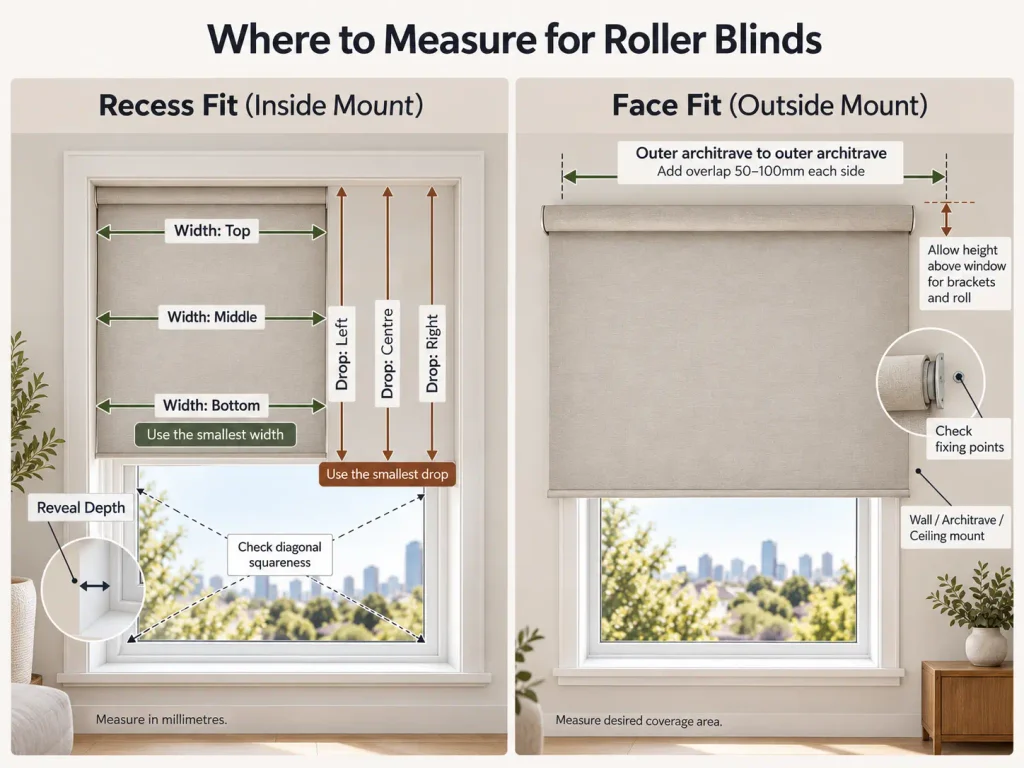
How to Measure Inside Mount Roller Blinds
Use millimetres, not centimetres.
Roller blinds are manufactured to tight tolerances, so rough measurements create real problems.
1. Measure Width at Top, Middle and Bottom
Measure the internal reveal width in three places:
- Top
- Middle
- Bottom
Use the smallest measurement.
This matters because if the reveal narrows at any point, the blind may scrape or bind if manufactured to the widest point.
2. Measure Drop at Left, Centre and Right
Measure the vertical drop in three places:
- Left
- Centre
- Right
Use the smallest measurement for a true inside mount.
If the sill slopes or the head is not level, the blind needs to account for that variation.
3. Measure Reveal Depth
Measure from the glass or obstruction point to the front edge of the reveal or architrave.
Do not measure only the plaster depth. Check handles, winders, flyscreens and security frames.
The blind must have enough depth to fit the bracket, tube, roll diameter and fabric path.
4. Check Diagonal Squareness
Measure corner to corner diagonally:
- Top left to bottom right
- Top right to bottom left
If those numbers differ significantly, the opening is out of square.
A blind can still be installed, but the installer may need to adjust deductions, recommend face fit, or avoid a tight recess mount.
5. Confirm Control Side
Decide whether the chain, motor or control should sit left or right.
This depends on access, furniture placement, safety, power availability and adjacent walls.
For motorised systems, the control side can affect power and bracket planning.
How to Measure for Face Fit Roller Blinds
Face fit measuring works differently because the blind covers the window from the outside.
1. Measure Outer Architrave or Desired Coverage
Measure the full area you want the blind to cover.
This may be:
- Outer architrave edge to outer architrave edge
- Wall-to-wall coverage
- A nominated fabric width
- A ceiling-mounted span across multiple windows
For best results, consider fabric coverage, not only bracket width.
2. Add Overlap Allowance
Where space permits, add overlap past the window opening.
A common allowance is around 50mm each side, though bedrooms or nurseries may benefit from more coverage if wall space allows.
Above the window, allow enough height for the roll, brackets and fabric stack.
3. Check Fixing Points
Face fit blinds need secure fixing.
Potential fixing points include:
- Timber architraves
- Wall studs
- Head plates
- Masonry
- Ceiling battens
- Structural framing behind plaster
Fixing into plaster alone is rarely ideal for large blinds.
The wider and heavier the blind, the more important the fixing structure becomes.
4. Check Obstacles Around the Window
Face fit blinds may clash with:
- Curtain tracks
- Door frames
- Air-conditioning units
- Wardrobes
- Wall lights
- Kitchen splashbacks
- Tiles
- Cornices
- Ceiling bulkheads
This should be checked before confirming bracket placement.
Comparison Matrix: Recess Fit vs Face Fit Roller Blinds
| Parameter | Recess Fit Performance | Face Fit Performance |
|---|---|---|
| Frame Depth Required | Needs sufficient reveal depth, typically around 50mm–75mm depending on system | Can work with shallow or unsuitable reveals because it mounts outside the opening |
| Light Leakage Risk | Higher side light gaps due to bracket and mechanism deductions | Lower side light leakage when overlap extends past the frame |
| Visual Profile | Sleek, integrated and minimal | Stronger framed appearance with more coverage |
| Handle Clearance | Can be difficult if winders, locks or sliding handles project into the reveal | Better for bypassing handles because the blind sits forward |
| Measuring Margin for Error | Low margin; reveal must be measured accurately at multiple points | Slightly more forgiving, but fixing points and overlap must be planned |
| Best For | Living rooms, studies, clean modern reveals, non-critical light control | Bedrooms, nurseries, media rooms, shallow reveals, problematic frames |
| Thermal Performance | Good if close to glass, but side gaps remain | Better edge coverage, especially with pelmets or curtains |
| Architrave Visibility | Keeps architraves visible | Covers part or all of the architrave depending on overlap |
| Suitability for Dual Rollers | Needs deeper reveal and careful bracket planning | Often easier due to more mounting flexibility |
| Installation Complexity | Higher if reveal is out of square or obstructed | Higher if wall fixing is difficult or multiple windows need alignment |
Smart Motorisation and Recess Integration
Motorisation changes the technical requirements.
A manual chain blind uses a clutch mechanism and chain control. A motorised blind uses a tubular motor inside the roller tube. That motor may be battery powered, hardwired or connected to a solar-recharge option depending on the system.
Motorised blinds are ideal for large windows, high reveals, bedrooms, smart homes and open-plan spaces with multiple blinds.
However, they still need correct mounting.
Recess Fit Motorised Blinds
Recess mounting a motorised blind requires enough room for the motor head, bracket set and fabric roll.
Battery motors may have slightly larger heads or access requirements. Some battery systems need charging access, so the installer must consider whether the blind can be reached easily.
Hardwired systems need planning before plastering where possible.
For new builds and renovations, this should be discussed early with the electrician, builder and window furnishing consultant.
Face Fit Motorised Blinds
Face fit motorised blinds often provide more flexibility.
There is usually more space for brackets and motor clearance. They can also be aligned across multiple windows to create a cleaner facade from inside the room.
For sliding doors or large glazing, face fit may allow stronger coverage and smoother operation.
The key is fixing strength.
Motorised blinds still require secure brackets, especially across wide openings.
The Ringwood Factory Advantage: Millimetre Precision
Off-the-shelf blinds fail most often in recess mounts.
The reason is simple: standard sizes do not account for real window variation.
A blind that is too wide can scrape, jam or damage the fabric edge. Make it too narrow, and the side gaps look excessive while allowing more light into the room. A weak tube may sag across wider openings, especially with heavier blockout fabrics. Poor fabric cutting can also cause frayed edges, uneven rolling or tracking problems over time.
Melbourne windows add extra complexity.
Timber frames expand and contract. Older architraves shift. New plaster reveals may vary slightly across the opening. Sliding doors can be wide and heavy. Heritage frames may sit visibly out of square.
Complete Blinds solves these issues through custom roller blinds Ringwood manufacturing.
Our team measures the window accurately, then custom-cuts tubes and fabrics to suit the actual opening. We account for mechanism deductions, fabric tracking, reveal depth, bracket size, handle clearance and final installation.
This process helps reduce:
- Scraping fabric
- Uneven side gaps
- Roller binding
- Excessive light leakage
- Tube sagging
- Poor roll tracking
- Misaligned brackets
- Awkward handle clashes
Factory-direct production also gives better control over finishes.
Bracket colours, base rails, chain controls, fabrics, motor options and pelmets can be specified to suit the room rather than forced from a limited retail range.
That matters in homes where the window furnishing needs to feel designed, not improvised.
Recess Mount vs Face Mount Blinds Melbourne: Installer Recommendation
For Melbourne homes, the most reliable choice depends on the room.
Choose recess fit if the reveal is deep, square and free of obstructions, and if you prefer a clean architectural look. It suits living rooms, studies and modern interiors where edge light is not a major concern.
Choose face fit if the room needs darkness, if the reveal is shallow, if handles intrude, or if the frame sits out of square. It suits bedrooms, nurseries, media rooms and older homes where the window opening cannot support a clean inside mount.
For luxury interiors, consider combining both concepts.
A recess fit roller can handle daytime privacy while curtains soften the room. A face fit blockout blind can hide behind a curtain track for stronger darkness. A motorised system can make either option easier to use.
The best result comes from measuring the room, not guessing from the window style.
Architectural FAQ
Sometimes, yes. If the blind is wide enough and the brackets suit the new position, it may be possible. However, many recess blinds are manufactured too narrow for ideal face fit coverage, so a new blind may give a better result.
Dual roller blinds usually need more depth than single rollers because two tubes and brackets sit in the same opening. Depending on the system and fabric, you may need well over 75mm. Shallow reveals often suit face fit dual rollers better.
Fabric veering usually comes from uneven brackets, an out-of-level tube, fabric tension issues, or an out-of-square reveal. Sometimes the fabric has also been pulled unevenly. A professional installer can adjust tracking, but severe issues may need remounting.
If the reveal has enough depth and is square, recess fit usually looks cleaner in square-set plaster. If the room needs stronger blackout, face fit or a concealed pelmet system may perform better.
Face fit usually offers better edge coverage, especially when paired with pelmets or curtains. Recess fit can sit closer to the glass, which helps in some cases, but side gaps reduce thermal sealing.
Not if it is planned well. Mounting the blind higher and wider can actually make the window feel larger. Poorly positioned face fit blinds can look bulky, so bracket height, fabric colour and overlap need careful design.
Final Recommendation
The choice between recess fit vs face fit roller blinds should start with the window, not the fabric book.
Check the reveal depth. Look for handles and locks. Measure the top, middle and bottom. Think about how much darkness the room needs. Consider whether the blind should disappear inside the frame or cover the window more completely.
Recess fit gives the cleanest built-in look when the reveal is deep and square.
Face fit gives stronger coverage, better handle clearance and improved light control when the window is shallow, uneven or used for sleep.
Complete Blinds can measure, manufacture and install custom roller blinds from our Ringwood factory hub, helping Melbourne homeowners, builders and designers choose the right mounting style with millimetre precision.
If you are unsure which option suits your windows, book a service enquiry below. Our team can assess your reveal depth, frame condition, light leakage needs and interior style, then recommend the correct fit for your home.


