


Quick Verdict: Roller blinds offer a sleek, cost-effective, minimalist profile that rolls completely away for maximum view. Roman blinds deliver soft, structured fabric folds with stronger insulation and a premium, curtain-like finish. The right choice depends on each room’s thermal needs, structural depth, light-control expectations, and budget in your Melbourne home renovation.
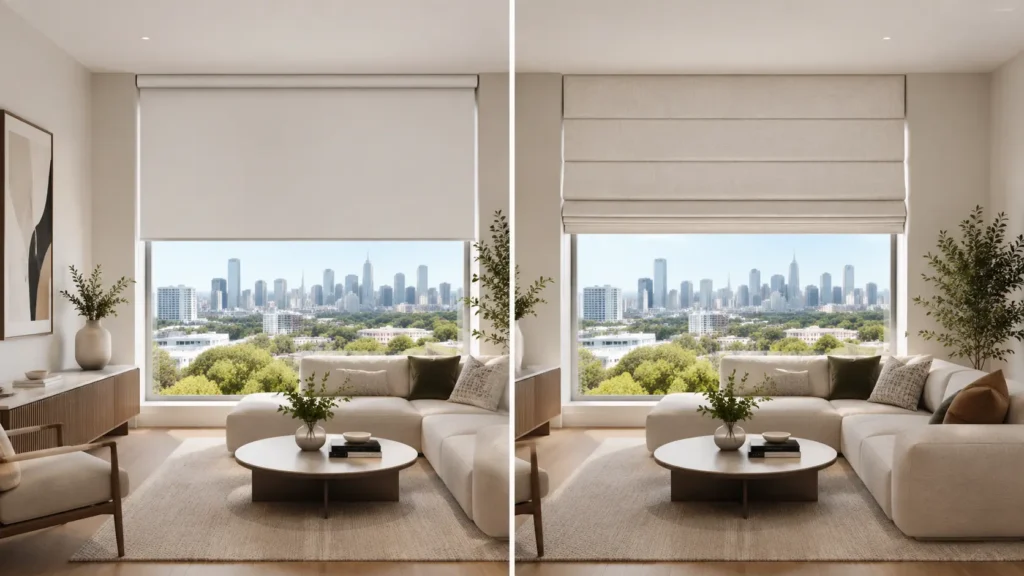
Choosing between roller blinds and Roman blinds creates one of the most common design dilemmas for Melbourne homeowners.
Both styles cover windows, improve privacy, manage light, and finish a room. But they create very different outcomes.
Roller blinds suit homeowners who want the window treatment to disappear. They support clean architecture, sharp plaster lines, large glazing, and modern interiors.
Roman blinds do the opposite. They make the window part of the design. Their folded fabric adds softness, texture, and a more tailored finish.
The wrong choice can affect the whole room.
A bulky Roman blind can make a shallow window look heavy. A single roller blind in a formal living room can feel too plain. A fabric Roman blind in a kitchen can trap moisture, grease, and odours. A poorly measured roller blind can leak light and frustrate anyone trying to create a dark bedroom.
Complete Blinds manufactures both styles through our factory-direct process in Ringwood. Our team measures and custom-makes blinds to suit each window, rather than relying on generic imported sizing.
That matters.
Accurate manufacturing helps Roman blinds stack evenly without sagging. It also helps roller blinds sit tightly within the reveal to reduce light leakage and create a cleaner finish.
Roller Blinds: The Minimalist Workhorse
Roller blinds offer one of the cleanest window furnishing options for modern Melbourne homes.
The system works simply. Fabric rolls around an aluminium tube. You operate it with a chain, spring mechanism, or motor. When raised, the blind rolls neatly at the top of the window. When lowered, it creates a flat, clean panel across the glass.
This simplicity gives roller blinds their biggest advantage.
They do not dominate a room.
Roller blinds work well in apartments, townhouses, home offices, bedrooms, media rooms, and open-plan living spaces. They suit interiors where the design brief calls for clean lines, minimal bulk, and practical light control.
Many homeowners choose blockout roller blinds in Melbourne because they want privacy, glare reduction, and stronger room darkening.
Blockout roller blinds can make a major difference in bedrooms, nurseries, theatre rooms, and west-facing living areas. They also help reduce glare on televisions, laptops, and polished surfaces.
Roller blinds usually cost less than Roman blinds.
They use less fabric, require fewer sewn components and take less time to manufacture. For large homes or projects with many windows, that cost difference can become significant.
Roller blinds also clear the glass better than Roman blinds.
When you raise them, the fabric rolls into a compact tube. This keeps more of the window open and preserves the view. That makes roller blinds a smart choice for homes with garden outlooks, city views, sliding doors, and large architectural windows.
The main weakness comes from style.
A roller blind can look cold or commercial when used without the right fabric, colour, or layering. This issue appears most often in formal living rooms, dining rooms, and heritage homes.
Designers often solve this by layering roller blinds with sheers or modern curtains in Melbourne.
In this setup, the roller blind manages privacy and blockout performance. The sheer or curtain adds softness, movement, and depth.
Roman Blinds: The Architectural Statement
Roman blinds bring a more decorative and tailored look to a room.
Instead of rolling around a tube, the fabric lifts into horizontal folds. These folds create the soft, structured appearance that makes Roman blinds feel more luxurious than most standard blind styles.
Roman blinds suit homeowners who want the window to contribute to the interior design.
They work particularly well in formal living rooms, dining rooms, master bedrooms, guest bedrooms, heritage homes, and high-end renovations.
A well-made Roman blind can feel similar to a curtain, but it operates with the control and structure of a blind. This makes it useful when a room needs softness but does not suit full-length curtains.
Roman blinds also offer strong insulation potential.
They use heavier textiles, linings, and layered fabric construction. These extra layers help reduce heat transfer through the window area. In older Melbourne homes with draughty windows or large glass sections, Roman blinds can help create a warmer, more comfortable space.
The pros and cons of Roman blinds usually come down to beauty versus practicality.
On the positive side, Roman blinds look premium. They suit decorative fabrics, match cushions, upholstery, bedding, wall colour, or timber tones.
They also add visual weight to rooms that feel too hard or empty.
On the negative side, Roman blinds always create a stack at the top of the window. That stack covers part of the glass when you raise the blind.
On tall windows, this may not cause a problem. On short windows, it can reduce daylight and make the window feel smaller.
Roman blinds also need more care when cleaning.
Dust can sit along the folds. Stains can become harder to treat than stains on many roller blind fabrics. In kitchens, laundries, and bathrooms, moisture and airborne residue can shorten the fabric’s life.
Homeowners searching for custom Roman blinds in Ringwood should understand the value of proper manufacturing.
A poorly made Roman blind can sag, twist, or fold unevenly. A custom factory-direct process helps control the fold spacing, lining, fabric weight, and finished shape.
That is the difference between a Roman blind that looks tailored and one that looks tired after a few months.
Roller Blinds vs Roman Blinds: Technical Head-to-Head
| Comparison Point | Roller Blinds | Roman Blinds |
|---|---|---|
| Relative Cost | Usually more affordable because they use simpler construction, less fabric, and fewer labour-intensive details. | Usually more expensive because they need more fabric, lining, sewing, fold construction, and detailed finishing. |
| Thermal Insulation | Good when you choose quality blockout or thermal-backed fabrics, although the fabric layer stays thinner than most Roman blind constructions. | Stronger insulation potential because heavier fabric layers and linings help reduce heat movement around the window. |
| Light Leakage Control | Excellent with accurate custom measuring, especially with face-fit installation or a carefully designed reveal fit. Poor measuring can leave side gaps. | Strong fabric coverage, especially with blockout lining, but the installation style still affects edge light leakage. |
| Maintenance & Cleaning | Easier to maintain. Many fabrics allow gentle dusting or light wiping, depending on the material. | Harder to clean because folds collect dust and decorative textiles need more careful handling. |
| Suitability for Motorisation | Very suitable. Roller tubes work smoothly with internal motors and suit frequent daily use. | Possible, but more complex because the lift system uses cords, rings, folds, and heavier fabric. |
| Stack Height | Minimal. The fabric rolls into a compact tube and clears most of the glass. | Larger. The fabric folds into a visible stack that always covers part of the glass. |
| Best Design Use | Modern, minimal, architectural, practical, and layered interiors. | Elegant, decorative, soft, formal, heritage, and luxury interiors. |
| Best Rooms | Bedrooms, apartments, living rooms, home offices, media rooms, and sliding doors. | Formal lounges, dining rooms, master bedrooms, guest rooms, and period homes. |
| Main Risk | They can look too plain if you choose the wrong fabric or skip layering in softer interiors. | They can look bulky or reduce daylight if the window depth and stack height do not suit the room. |
The 2026 Design and Melbourne Suburb Filter
Melbourne homes vary widely in style.
A new townhouse in Box Hill needs a different window treatment from a restored period home in Brighton. A large family home in Glen Waverley may need a different approach from a luxury renovation in Toorak.
In modern areas such as Box Hill, Glen Waverley, Doncaster, and Ringwood, roller blinds often suit the architecture best.
These homes often feature large glass doors, aluminium windows, clean plaster lines, open-plan kitchens, engineered flooring, and minimal detailing.
Roller blinds support that style because they keep the window line clean. They also work well when paired with S-fold sheers for softness.
This is why many ultra-modern homes choose blockout roller blinds in Melbourne living zones, bedrooms, and media rooms.
In apartments and townhouses, roller blinds also help preserve space. They sit close to the glass and avoid the fabric bulk that can make a compact room feel smaller.
Roman blinds suit a different design direction.
In Toorak, Brighton, Camberwell, Canterbury, Kew, and similar suburbs, homeowners often use custom linen Roman blinds to add warmth and depth.
These homes may include timber floors, decorative mouldings, stone fireplaces, high ceilings, wall panelling, or traditional architectural details.
A textured Roman blind can soften these spaces without needing full-length curtains. This works especially well where furniture placement, heating, or joinery makes curtains impractical.
The key is proportion.
Roller blinds preserve sharp architecture. Roman blinds add textile weight and softness.
Neither option wins in every home. The right answer depends on window depth, ceiling height, room use, furniture placement, and the level of formality you want.
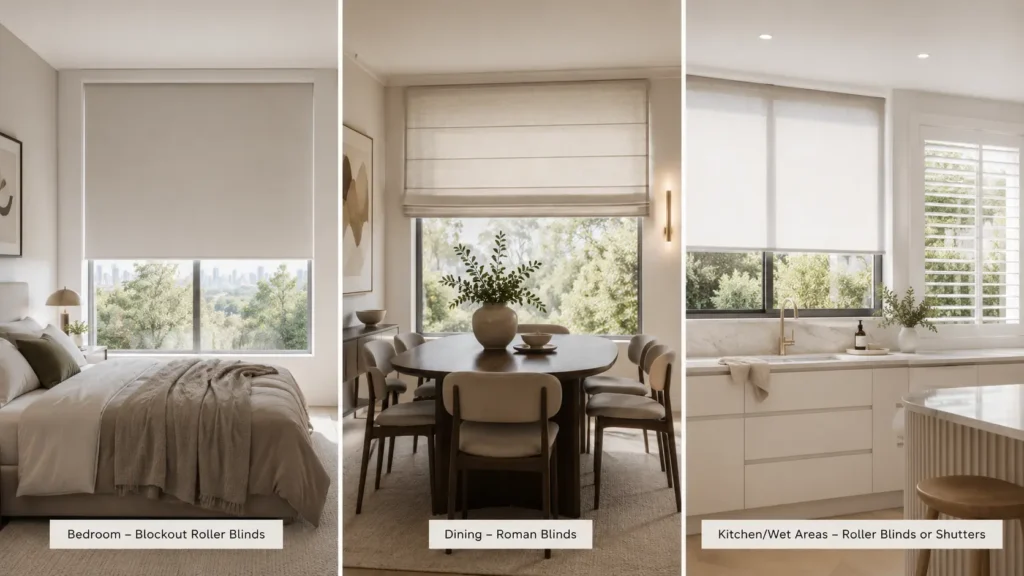
Room-by-Room Recommendations
Formal Living Areas and Dining Rooms
Roman blinds often work best in formal living rooms and dining areas.
These rooms can handle a stronger design feature at the window. A textured Roman blind frames the opening, adds softness, and gives the room a more finished appearance.
In dining rooms, Roman blinds can also help soften sound. This matters in spaces with timber floors, stone benchtops, glass doors, and hard plaster surfaces.
A Roman blind feels more furnished than a single roller blind. It also gives the room a tailored, decorator-level finish.
Roller blinds can still work in formal spaces, but they usually need layering.
A blockout roller behind a sheer curtain gives strong function and a softer look. This approach works well when homeowners want modern performance without making the room feel bare.
Bedrooms
Bedrooms need more technical planning than many homeowners expect.
You need privacy, darkness, temperature control, and comfort.
Dual roller blinds offer a practical solution. A sunscreen or light-filtering blind gives daytime privacy. A blockout roller provides night-time darkness.
This gives the bedroom flexibility across the whole day.
Heavy blockout Roman blinds can also work beautifully in bedrooms. They suit master suites, guest rooms, and spaces where the fabric can connect with bedding, carpets, wallpaper, or upholstered bedheads.
Roman blinds can also improve comfort in colder rooms because the thicker fabric layer adds insulation.
However, stack height matters.
If the bedroom window is short, the Roman blind stack may cover too much glass during the day. If the room already lacks natural light, roller blinds may provide a better result.
Kitchens and Wet Areas
Kitchens, bathrooms, laundries, and powder rooms require practical thinking.
Fabric Roman blinds rarely suit these spaces. They can absorb cooking oils, steam, moisture, and odours. Over time, this can lead to staining, fabric movement, or hygiene issues.
Roller blinds made from suitable moisture-resistant or easy-clean fabrics usually perform better in kitchens and laundries.
They sit flat, clean more easily and do not have folds that trap grease and dust.
Bathrooms need even more caution.
Where moisture creates a major concern, consider durable alternatives such as Plantation Shutters. They can offer privacy, ventilation, and better long-term performance where fabrics may fail.
The Automation Showdown
Smart home automation continues to grow across Melbourne renovations and new builds.
Many homeowners now want window furnishings that connect with remotes, wall switches, apps, timers, or broader smart home systems.
Roller blinds adapt to automation more easily.
The motor sits inside the roller tube. This creates a simple and reliable movement. Quality systems such as Somfy® or Automate® can operate single blinds, groups of blinds, or full-room settings.
This makes motorised blinds especially useful for large sliding doors, high windows, bedrooms, and living areas with multiple blinds.
Roller blinds move smoothly. They stop consistently. They handle daily use well.
Roman blinds can also use motorisation, but the system requires more careful design.
A Roman blind relies on cords, rings, lift lines, and fabric folds. The motor must lift the fabric evenly while keeping the stack neat.
This can work well with expert manufacturing and installation. However, it leaves less room for error than a roller tube system.
If automation sits high on your priority list, roller blinds usually offer the cleaner option.
If you want softness and luxury first, a motorised Roman blind can still work, but it needs careful specification.
Cost of Roman Blinds vs Roller Blinds
The cost of Roman blinds vs roller blinds depends on window size, fabric selection, lining, motorisation, installation type, and the number of windows.
In most cases, roller blinds cost less.
They use fewer materials, need less labour and suit whole-home projects where the budget must cover many rooms.
This makes roller blinds popular for apartments, investment properties, new builds, bedrooms, offices, and family homes.
Roman blinds sit in a more premium category.
They use more fabric and require more detailed manufacturing. Decorative textiles, linings, trims, and motorisation can increase the final price.
The smarter question is not simply, “Which option costs less?”
A better question is, “Where should I invest more?”
Many Melbourne homes benefit from a mixed approach. Use roller blinds in bedrooms, studies, utility areas, and large glazing zones. Use Roman blinds in feature rooms such as the master bedroom, formal lounge, or dining room.
That way, the budget supports both performance and design impact.
Factory-Direct Customisation from Ringwood
Complete Blinds operates as a factory-direct provider in Ringwood.
That gives homeowners a major advantage over off-the-shelf blind solutions.
Our team can measure, manufacture, and install roller blinds and Roman blinds to suit the actual window, not a generic size chart.
For roller blinds, this means cleaner reveal fitting, better fabric selection, smoother operation, and reduced light leakage.
For Roman blinds, it means correct fold spacing, suitable lining, stable construction, and a stack that sits neatly without looking heavy or uneven.
This level of customisation matters because windows rarely behave perfectly.
Reveals can sit out of square. Architraves can vary. Older Melbourne homes often have inconsistent depths. New builds often include large glass areas that need careful weight, fabric, and motor planning.
A custom-made blind should not simply cover a window.
It should work with the architecture, improve comfort, and suit the way the home functions every day.
FAQs: Roller Blinds vs Roman Blinds
Roman blinds usually cost more than roller blinds.
They need more fabric, lining, sewing, fold construction, and finishing. Roller blinds use a simpler system, so they generally offer a more cost-effective option for larger homes or multi-window projects.
Roman blinds can block strong light when they use heavy fabric and quality blockout lining.
However, roller blinds can often control light more precisely when the installer measures and fits them correctly. A well-designed blockout roller blind can perform extremely well in bedrooms, nurseries, and media rooms.
No. A Roman blind always creates a fabric stack at the top of the window when raised.
That stack covers part of the glass. The amount depends on the window height, fabric thickness, fold design, and installation position.
If you want to preserve the full view, roller blinds usually provide the better option.
Yes, you can mix both styles, but the design needs control.
Use each blind style for a clear reason. For example, roller blinds may suit large sliding doors, while Roman blinds may frame smaller feature windows.
Keep fabric tones, textures, and hardware finishes coordinated so the room feels intentional.
Use a soft brush attachment or gentle vacuum setting to remove dust from Roman blinds regularly.
Treat stains carefully because cleaning methods depend on the fabric. Avoid harsh chemicals unless the fabric supplier approves them.
For heavy staining, seek professional cleaning advice. Avoid Roman blinds in kitchens and wet areas because fabric folds can trap moisture, residue, and odours.
No. Roman blinds still suit modern Melbourne homes when designers use them in the right rooms.
In 2026, many homeowners choose roller blinds for minimal architectural spaces and Roman blinds for rooms that need warmth, softness, and a premium textile finish.
The best interiors do not force one blind style through the whole home. They match the blind to the room.
Final Recommendation
Choose roller blinds if you want a clean, minimal, cost-effective window furnishing that preserves the view, suits automation, and works across most modern Melbourne homes.
They suit bedrooms, apartments, living areas, home offices, media rooms, and large glazing.
Choose Roman blinds if you want softness, insulation, texture, and a premium designer finish.
They suit formal living rooms, dining areas, master bedrooms, heritage homes, and luxury renovations where the window should contribute to the interior design.
For many homes, the best answer is not roller blinds or Roman blinds.
It is a considered combination.
Use roller blinds where function, simplicity, and automation matter most. Use Roman blinds where the room needs warmth, proportion, and a tailored fabric feature.
With factory-direct custom production from Complete Blinds in Ringwood, both options can fit properly, operate reliably, and suit the way your Melbourne home works every day.


