


Quick Verdict: Layering S-Fold sheer curtains over recess-mounted blockout roller blinds combines soft daytime light with practical night-time privacy. Sheers diffuse glare and screen daytime views; the roller provides room darkening and an added insulating layer. Plan roughly 60–80 mm of separation from protruding blind hardware, then verify actual wave depth and bracket clearances before final installation.
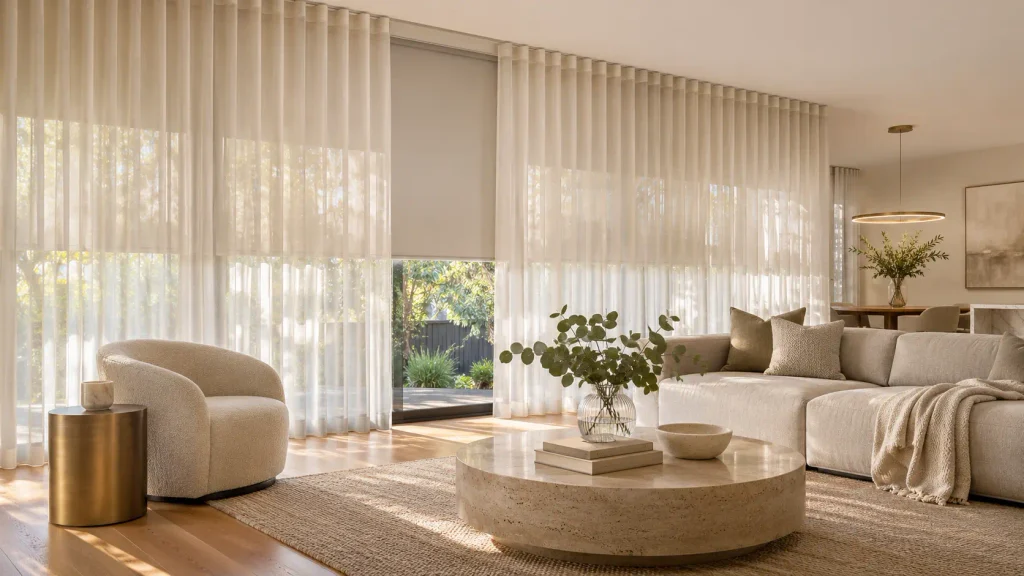
There is something distinctly luxurious about full-height sheer curtains falling in soft, continuous waves across a Melbourne living room. Natural light filters through the fabric, hard architectural lines disappear, and even a modest window feels more generous.
However, beautiful sheer curtains alone cannot provide reliable privacy after sunset. Equally, practical roller blinds can sometimes make a carefully styled interior feel unfinished.
The solution is to combine both.
Installing sheer curtains over roller blinds Melbourne homeowners can customise provides two independent layers: elegant, light-filtering fabric at the front and practical blockout protection behind.
This combination works beautifully in contemporary townhouses, renovated Victorian homes, modern apartments and spacious family residences.
Yet successful layering requires more than choosing matching fabrics. Window reveal depth, roller orientation, curtain track placement and precise hardware clearances determine whether both systems operate smoothly.
At Complete Blinds, our Ringwood manufacturing team brings these elements together through custom measurement, made-to-measure window furnishings and professional Melbourne installation.
Why Layering Is Transforming Modern Melbourne Interiors
Contemporary interiors increasingly favour large windows, open-plan layouts and streamlined finishes.
Although these architectural choices create beautiful spaces, they also introduce practical challenges.
A standalone roller blind offers excellent functionality but can appear stark against large plaster walls and aluminium window frames.
Sheer curtains soften those surfaces, but their translucent construction cannot provide dependable night-time privacy when interior lights are switched on.
Layering solves both problems.
Four Benefits of Layered Window Furnishings
1. Flexible daylight and privacy
Keep the sheer curtains closed during the day to diffuse strong sunlight and reduce direct views into the room. At night, lower the blockout blind for greater privacy.
Daytime screening depends on fabric density and lighting conditions; sheers do not create complete visual privacy.
2. A softer, more luxurious interior
Full-height S-Fold curtains introduce graceful movement and texture without overwhelming the room.
Their continuous vertical lines can make standard 2.4m and 2.7m ceilings appear taller.
3. Improved comfort near windows
A blockout roller blind helps reduce unwanted sunlight and creates an additional layer between the glass and interior.
Combined with curtains, it can also improve perceived comfort, although actual thermal performance depends on fabric construction, glazing and installation gaps.
4. Reduced acoustic harshness
Soft furnishings absorb some reflected sound, helping reduce the sharp echo associated with tiled floors, glass and hard plaster surfaces.
Sheer curtains are not soundproofing, but they can make a room feel acoustically softer.
For homeowners exploring modern curtains in Melbourne, combining sheers with roller blinds provides an elegant balance between appearance and everyday practicality.
The Anatomy of the Perfect Combination: S-Fold Sheers and Recess Roller Blinds
A successful layered window treatment uses two systems that perform different functions.
The roller blind handles light blocking and privacy, while the sheer curtain provides softness, texture and visual continuity.
The Back Layer: Recess-Mounted Blockout Roller Blinds
The roller blind should ideally sit inside the window reveal, allowing the curtain to glide freely in front.
This is known as a recess fit or inside mount.
The roller’s tube, brackets and fabric remain visually contained within the window opening wherever sufficient depth is available.
When the blind is raised, the fabric rolls neatly towards the head of the window.
When lowered, the blockout material provides privacy and substantial room darkening.
However, blockout fabric does not automatically create a completely dark room. Recess-mounted blinds normally leave small side gaps around their operating hardware.
For bedrooms requiring stronger light exclusion, side channels, suitable pelmets or additional overlap may be worth considering.
Explore Complete Blinds’ blockout roller blinds for fabric and design options.
Standard Roll vs Reverse Roll: Which Is Better?
Roller orientation affects both appearance and clearance.
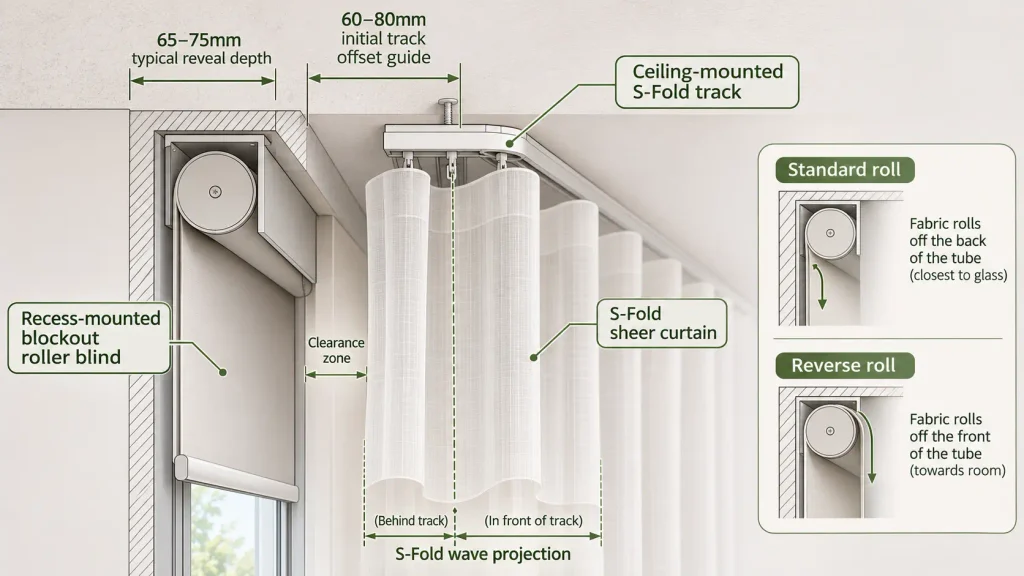
Standard roll (back roll): The fabric descends from the window side of the roller tube, generally keeping it closer to the glass.
This can improve coverage near the window but may interfere with projecting handles, winders or locks.
Reverse roll (front roll): The fabric descends from the room-facing side of the tube, positioning it further away from the glass.
This can help clear window hardware, although it may increase the space required in front of the blind.
Neither orientation is universally better.
An experienced installer checks the fabric path, window hardware and curtain track position before recommending the arrangement.
The Front Layer: Ceiling-Mounted S-Fold Sheer Curtains
S-Fold curtains, also called wave-fold curtains, use specially spaced track carriers to create regular, flowing waves.
Unlike traditional pinch-pleat headings, which gather fabric into defined pleats at the top, S-Fold systems maintain a smooth, rhythmic appearance along the entire track.
This makes them particularly attractive for layered window furnishings in living rooms.
Their main advantages include:
- Consistent fabric folds across wide windows
- Clean, contemporary track detailing
- Smooth movement along the curtain track
- Elegant full-height proportions
- A soft architectural finish without bulky headings
Pinch-pleat curtains remain a valid design choice, but S-Folds are especially well suited to the minimalist, hotel-inspired appearance many Melbourne homeowners prefer.
The Technical Rules of Clearance: Preventing Snags and Collisions
The most common mistake when layering curtains over blinds is measuring each product independently.
A roller blind may fit perfectly within the window. A sheer curtain track may also fit correctly against the ceiling.
However, when both systems operate together, the curtain fabric can brush against the roller brackets, cassette or operating chain.
This happens because the S-Fold heading extends both behind and in front of the curtain track.
Rule 1: Check the Window Reveal Depth
For many standard roller blind systems, a reveal depth of approximately 65–75mm is a useful starting point for a flush installation.
However, the actual requirement depends on the tube diameter, bracket design, fabric thickness and blind drop.
Some compact systems need less depth, while larger rollers and cassettes require more.
Before manufacturing, measure:
- Reveal depth from the glass or nearest obstruction to the front edge
- Width at the top, centre and bottom
- Drop at the left, centre and right
- Window handle and winder projections
- Available bracket fixing surfaces
- Clearance for the fully rolled fabric
If the reveal is too shallow, the installer may recommend a face-mounted blind or a different bracket system.
Rule 2: Allow Sufficient Clearance Between the Roller Blind and Curtain
For many layered installations, 60–80mm is a useful initial allowance between the nearest projecting blind hardware and the centreline of the sheer curtain track.
However, this is a planning guide, not a universal minimum.
S-Fold curtains move in waves, and part of each wave projects behind the track.
Depending on the track and fabric configuration, the entire wave may occupy approximately 110–130mm or more from front to back.
Therefore, the track must be positioned far enough forward that the rear-facing folds do not contact the roller blind, brackets, chain or architrave.
A deeper S-Fold heading may require an offset greater than 80mm.
Rule 3: Measure from the Most Protruding Surface
A common installation mistake is measuring the curtain track position from the plaster wall without accounting for the architrave.
For example, if the architrave projects beyond the wall, the curtain needs to clear that projection as well.
The same applies to face-mounted rollers, bulky brackets and exposed control mechanisms.
Installer’s rule: Measure from the furthest projecting obstruction, calculate the rearward depth of the curtain wave, then allow enough additional space for smooth movement.
The finished curtain should not rub against any part of the roller mechanism.
Rule 4: Choose Ceiling-Mounted or Recessed Tracks
Ceiling-mounted S-Fold tracks are generally the preferred option for contemporary interiors.
Positioning the track close to the ceiling creates a long, uninterrupted curtain drop.
For new builds or major renovations, the track can sometimes be concealed inside a purpose-designed plaster recess.
This creates the appearance of fabric descending directly from the ceiling.
Where ceiling mounting is unsuitable, wall-mounted tracks with correctly sized projection brackets can achieve a similar effect.
In every case, fixing points must be structurally appropriate. A plaster ceiling alone may not provide sufficient support without suitable backing or anchors.
Technical Installation Checklist
| Component | Typical Planning Guidance | Installer’s Consideration |
|---|---|---|
| Roller reveal depth | Approximately 65–75mm for many single rollers | Confirm actual tube and bracket dimensions |
| Curtain track offset | Start with 60–80mm beyond projecting hardware | Increase where S-Fold wave depth requires |
| S-Fold fabric depth | Often approximately 110–130mm overall | Depends on track spacing and fullness |
| Curtain floor clearance | Approximately 10–15mm for a neat floating finish | Allow for uneven floors and fabric movement |
| Roller orientation | Standard or reverse roll | Check handles, winders and curtain clearance |
| Curtain stack-back | Project-specific | Keep sliding doors and handles accessible |
These measurements are guidelines rather than fixed specifications. Final dimensions should be checked against the selected products before manufacturing.
Colour and Texture Pairing: A Melbourne Interior Designer’s Guide
The appeal of a blockout roller blind and sheer curtain combo depends heavily on fabric coordination.
Because two different materials occupy the same window, their colours and textures should feel intentional.
Style 1: Tone-on-Tone Monochromatic
For a calm, contemporary interior, pair a warm white blockout roller blind with an ivory or oatmeal sheer.
The similar tones help the roller blend into the background when lowered.
Meanwhile, the translucent sheer introduces subtle texture without creating strong colour contrast.
This combination works beautifully with:
- Pale oak flooring
- Natural stone benchtops
- Warm white walls
- Beige and taupe furniture
- Minimalist timber joinery
It’s especially effective in modern Ringwood, Glen Waverley and Doncaster homes where natural materials and neutral palettes are preferred.
Style 2: High-Contrast Architectural
For a more dramatic appearance, combine charcoal or textured grey roller blinds with soft ivory linen-look sheers.
The darker backing creates visual depth while the lighter front layer keeps the overall treatment delicate.
This style suits industrial-inspired apartments, contemporary townhouses and living areas with black aluminium window frames.
For strong western sun, consider the backing’s solar-performance characteristics rather than selecting fabric solely by its interior colour.
Style 3: Soft Coastal Neutrals
Pair light stone or sand-coloured roller blinds with airy white sheers.
The combination creates a relaxed appearance without excessive decorative detail.
It works particularly well in bright, open-plan homes with timber flooring, muted furnishings and generous glazing.
Choosing Fabrics by Window Orientation
Melbourne’s orientation and seasonal sunlight should also influence your choices.
| Window Orientation | Recommended Sheer Opacity | Roller Blind Backing Type | Main Priority |
|---|---|---|---|
| North-facing | Light to medium-density sheer | Blockout with suitable solar-control backing | Manage seasonal sun while retaining daylight |
| West-facing | Medium to denser sheer | Blockout with reflective or light-coloured outward-facing backing, where appropriate | Reduce harsh afternoon sun and glare |
| South-facing | Lightweight translucent sheer | Standard blockout backing suited to the room | Preserve soft daylight and improve privacy |
East-facing bedrooms may also benefit from blockout rollers to control early morning sunlight.
Always assess the window’s actual shading, glazing type and nearby buildings before selecting fabrics.
Automating Your Layered Window Furnishings
For the cleanest appearance, consider replacing exposed roller chains with motorisation.
A motorised roller blind uses an electric motor inside the roller tube, while a motorised S-Fold curtain track uses a separate drive mechanism to move the curtains horizontally.
With compatible technology, the two systems can operate through remote controls, wall switches or programmed routines.
Somfy and Automate Motorisation
Selected Somfy® and Automate® systems provide remote operation and smart-home integration.
Depending on the motor and control platform, homeowners may create routines such as:
- Opening the sheer curtains in the morning
- Lowering blockout blinds before sunset
- Closing west-facing rollers during strong afternoon sunlight
- Controlling several windows from one remote or app
The convenience offered by motorised blinds can extend to indoor roller blinds and motorised curtain tracks, although indoor and outdoor products require appropriately specified hardware.
Important: A Somfy roller motor and an Automate curtain motor will not necessarily operate from the same remote without a compatible integration system.
For a seamless arrangement, select the motor, curtain track and control platform together.
Homeowners renovating existing properties can also consider rechargeable roller motors and compatible motorised curtain-track options, subject to the available power supply and installation requirements.
Room-by-Room Applications for Melbourne Homes
Open-Plan Living Rooms and Sliding Alfresco Doors
Large sliding doors often form the visual centrepiece of modern Melbourne living areas.
Full-height S-Fold sheers soften the glass and frame the outdoor view beautifully.
However, curtain stacking requires careful planning.
Stack-back refers to the space occupied by the curtain when fully opened.
If insufficient space is available beside the door, the gathered fabric may partially obstruct the opening.
For a successful installation:
- Extend the curtain track beyond the glass where wall space allows.
- Position the stack away from frequently used door panels.
- Check handles, sliding tracks and door movement.
- Consider a split-draw arrangement for wide openings.
- Ensure the roller blind finishes clear of door hardware.
For open-plan living, the roller blind can remain raised during the day while the sheers gently filter the light.
Master Bedrooms: The Hotel-Suite Effect
Bedrooms benefit from layering because privacy, darkness and softness are equally important.
Choose a blockout roller for night-time privacy and room darkening, then add full-height S-Fold sheers in a soft neutral fabric.
The sheers create an elegant finish and help reduce harsh sound reflections.
For stronger morning light exclusion, consider a suitable cassette, side-channel system or additional coverage around the window.
Standard recess-mounted blockout blinds may still allow light through their side gaps.
When Layering Is Not the Best Solution
Not every window needs two treatments.
Kitchens: Curtains close to cooking surfaces can collect grease and may create a safety concern. Standalone roller blinds are often more practical.
Laundries: Moisture-resistant, easily cleaned window furnishings may be preferable to full-length fabric curtains.
Very narrow rooms: If the necessary curtain projection interferes with circulation or furniture, a single roller blind may provide a cleaner solution.
For homeowners who prefer structured architectural framing, Plantation Shutters offer adjustable louvres and a more rigid finish.
The right choice depends on available space, room function and the desired appearance.
Why Choose Complete Blinds for Custom Layered Window Furnishings?
Layered installations demand precision.
Off-the-shelf blinds and curtains may look compatible in a showroom but create problems once installed together.
A protruding roller bracket can interrupt the curtain’s movement. An incorrectly positioned track may cause fabric to catch against a chain or cassette.
Even a small measurement error can affect the finished appearance.
At Complete Blinds, our Ringwood factory manufactures custom blinds and curtains to suit individual windows.
Our team assesses the complete layered arrangement, including:
- Roller bracket projection and mounting position
- Window reveal depth and hardware obstructions
- Curtain track offset and S-Fold wave depth
- Fabric colour, texture and privacy requirements
- Curtain stack-back and floor clearance
- Suitable motorisation options
This coordinated approach helps create window furnishings that look refined and operate smoothly.
From contemporary Melbourne apartments to family homes in the eastern suburbs, custom measuring and professional installation make the difference between two separate products and one cohesive design.
Frequently Asked Questions
Allow approximately 60–80mm as an initial track-offset guide from projecting roller hardware, then verify the actual wave depth. S-Fold fabric projects behind the track, so some installations need more space. The curtain must move without touching the roller brackets or operating mechanism.
Not necessarily. Matching warm neutral colours creates a seamless appearance, while darker rollers beneath light-coloured sheers introduce contrast. Choose fabrics that complement the room’s walls, flooring and window frames.
No. For a neat, practical finish, allow approximately 10–15mm of clearance above the finished floor. This is generally described as a floating finish. A true floor-kissing curtain finishes at or very close to the floor, while puddling deliberately leaves extra fabric resting on it.
Yes. However, the curtain track needs sufficient projection to clear the entire roller mechanism, including brackets, cassette and chain. A custom track position or extended brackets may be necessary.
They can improve comfort when paired with suitable fabrics and close-fitting installation. The blockout blind provides an additional insulating
Book Your Free In-Home Measure & Quote
Ready to transform your windows with elegant S-Fold sheer curtains and blockout roller blinds? Complete Blinds offers custom-made window furnishings from our Ringwood factory, with professional measuring and installation across Melbourne. Fill out the Book a Service form below to discuss your requirements and arrange a free in-home measure and quote.


