


Quick Verdict: For new builds and major renovations, hard-wired motorised blinds are usually the better long-term choice, especially for tall or heavy window furnishings. In an existing Melbourne home, solar-assisted wire-free blinds often make more sense: no wall chasing, no new electrical cabling, and less charging to remember. The catch is getting enough daylight through your glass.
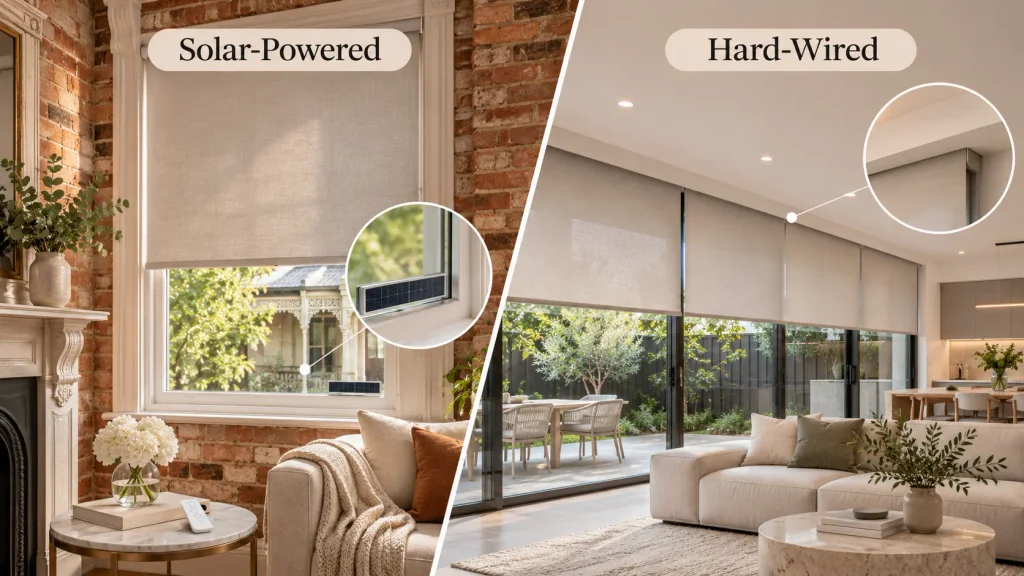
Motorised blinds sound like a straightforward home improvement. Choose your fabric, select a motor, press a button and enjoy effortless window control.
Then somebody mentions the electrician.
For Melbourne homeowners renovating an established property, running electrical cables through finished walls can become one of the most expensive parts of the project. A simple blind upgrade can suddenly involve drilling, plaster repairs and repainting.
That’s particularly frustrating in older double-brick homes around Camberwell, Hawthorn and Toorak, where concealing new cables isn’t always easy.
Fortunately, modern rechargeable motors offer another option.
Solar-assisted wire-free blinds allow many homeowners to automate their windows without installing new fixed electrical wiring. Meanwhile, hard-wired systems remain an excellent choice for new homes, large openings and demanding applications.
So, which is better: solar powered vs hard wired motorised blinds?
The answer depends on your home’s construction, window dimensions, available daylight and what you expect from your smart blinds.
At Complete Blinds, we’ve been manufacturing custom window furnishings in Melbourne since 1989. From our Ringwood factory, we help homeowners and builders select suitable motorisation systems, including Automate® and Somfy® options.
Here’s what you should understand before deciding.
How Hard-Wired Motorised Blinds Work
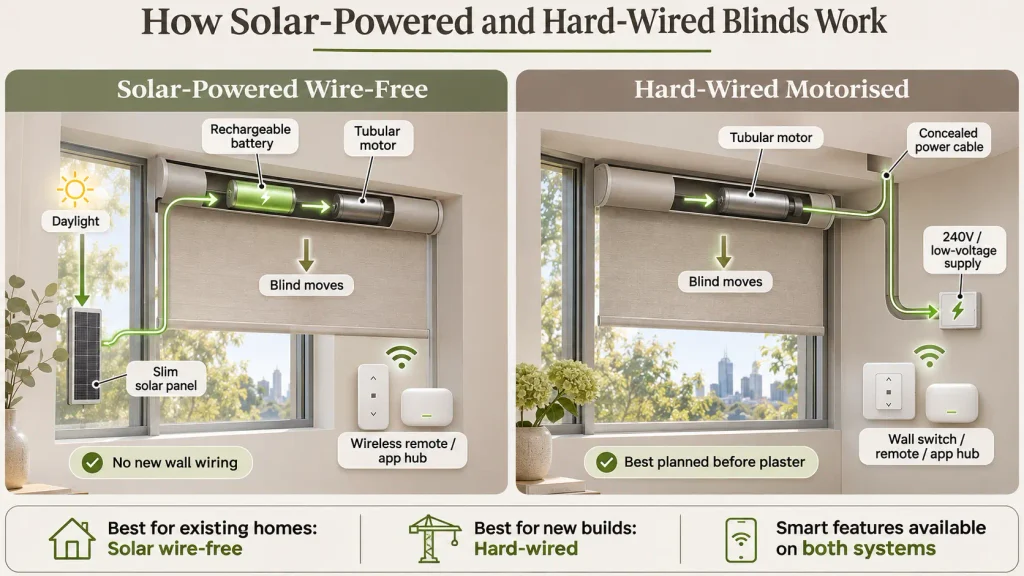
Hard-wired motorised blinds receive electricity from a permanent power connection rather than relying on a rechargeable battery.
They are particularly suitable for new homes and major renovations because wiring can be incorporated into the building before plasterboard installation.
Understanding 240V AC and Low-Voltage DC Motors
There are two common electrical arrangements.
240V AC motors operate using mains electricity. Suitable models are commonly used for larger blinds, demanding installations and applications requiring permanent power.
Low-voltage DC motors operate at a lower voltage, such as 12V or 24V, supplied through an appropriate transformer or power system.
Both arrangements can provide dependable automation.
However, a low-voltage motor doesn’t automatically mean the associated electrical installation can be completed without an electrician.
According to Energy Safe Victoria, new fixed electrical installation work must be undertaken by appropriately licensed electrical workers through a registered electrical contractor.
This is an important distinction for homeowners considering hard-wired electric blinds in a new build.
Why Hard-Wired Blinds Suit New Homes
Imagine you’re building a modern townhouse in Glen Waverley.
The electrical contractor is already installing lighting circuits, power points and other services. Planning appropriate connections for motorised blinds at the same time can be relatively straightforward.
Once the walls are finished, however, installing those same connections becomes more complicated.
Hard-wired systems offer several advantages:
- No routine battery charging: The motor receives power whenever the electrical supply is available.
- Heavy-duty motor options: Suitable motors can handle wide roller blinds and demanding installations.
- Concealed wiring: Cables can be hidden within walls, ceilings and recessed pelmets.
- Convenient high-window operation: There’s no battery to recharge at difficult-to-access windows.
- Home automation integration: Compatible systems can connect with selected smart-home and building automation controls.
These benefits become especially valuable for double-height windows or wide living-room blinds.
What Are the Disadvantages?
Retrofitting is the main drawback.
Running electrical cables through finished plaster or double-brick walls may require drilling, wall chasing and subsequent repairs.
Electrical costs can vary considerably. While preliminary renovation budgets sometimes allow $150–$300 per window for electrical work, this is not a reliable fixed price. Difficult access, multiple cable routes and additional repairs can push costs higher.
Hard-wired blinds also aren’t completely maintenance-free. Motors, controls and mechanical components can still require servicing.
And during a power outage, conventional hard-wired blinds generally stop operating unless a suitable backup power system is installed.
Installer’s advice: If you’re building or renovating, discuss motorised blinds with your builder before the electrical rough-in and plastering stages. Planning the wiring early is usually easier than adding it afterwards.
How Solar-Powered Wire-Free Blinds Work
Now imagine a different situation.
You’ve renovated your living room, painted the walls and installed new flooring. You’d love automated blinds, but cutting into the plaster isn’t an option.
This is where solar-assisted wire-free motorisation becomes attractive.
How Does the Solar System Actually Work?
A solar-powered blind doesn’t normally operate directly from sunshine.
Instead, it uses three components:
- Rechargeable motor: A tubular motor containing or connected to a rechargeable battery.
- Solar charging panel: A compact photovoltaic panel that collects available daylight.
- Wireless control: A remote, wireless wall control or compatible smart-home system.
The battery powers the motor whenever the blind moves.
Meanwhile, the solar panel gradually replenishes the battery’s charge.
Think of the panel as a battery charger rather than the blind’s immediate power source.
This means the blind can still operate after sunset or during cloudy weather, provided the battery contains sufficient charge.
Why Wire-Free Blinds Are Ideal for Renovations
Solar-assisted battery motors are particularly useful for established Melbourne homes.
Suitable blinds can often be installed without adding electrical wiring, opening finished walls or repairing plaster.
That makes them appealing for double-brick homes, upstairs bedrooms, apartments and renovated living areas.
Where no new fixed electrical work is required, installation generally doesn’t need an electrician.
However, motor selection and professional fitting still matter.
The roller tube, fabric weight, brackets and available mounting space must suit the selected motor.
Where Does the Solar Panel Go?
For compatible indoor systems, the panel can be positioned near the window glass, with its collecting surface facing outdoors.
A short cable connects it to the rechargeable motor or battery pack.
Slim panels can look discreet, particularly when positioned near the upper edge of the glass.
However, they aren’t necessarily invisible.
Their appearance depends on the window frame, mounting position and available light.
Most importantly, the panel needs to receive enough usable daylight to recharge the battery effectively.
Are Solar Blinds Maintenance-Free?
Not entirely.
A well-positioned panel may significantly reduce the need for manual charging, but solar performance varies from window to window.
Some installations may still need an occasional manual top-up.
Battery components also age over time.
Therefore, solar-powered blinds are best described as low-maintenance rather than maintenance-free.
Solar Powered vs Hard Wired Motorised Blinds: Technical Comparison
Both systems offer convenient automation, but their installation requirements and long-term advantages differ.
| Feature | Solar-Powered Wire-Free | Hard-Wired Motorised Blinds |
|---|---|---|
| Best suited to | Existing homes and renovations | New builds and major renovations |
| Power source | Rechargeable battery with solar charging | Permanent 240V AC or suitable DC supply |
| Electrician required | Usually no, if no fixed wiring is added | Yes, for new fixed electrical work |
| Installation disruption | Generally minimal | Low during construction; potentially significant in finished homes |
| Installation cost | Often more economical for retrofits | Often competitive when wiring is planned early |
| Lifting capacity | Depends on motor torque and battery specifications | Wider selection of high-torque motor options |
| Routine charging | Reduced through solar charging; occasional top-ups may be needed | No routine battery charging |
| Long-term maintenance | Battery, panel and motor may need attention | Motor and controls may need attention |
| Smart-home compatibility | Available with compatible motors and hubs | Available with compatible motors and interfaces |
| Appearance | Concealed motor; solar panel may remain visible | Concealed motor and wiring |
| Power outages | Can operate while the battery has charge | Generally stops without backup power |
| Best applications | Bedrooms, retrofits and smaller residential blinds | High voids, large blinds and integrated automation |
Does Hard-Wired Mean a Stronger Motor?
Not automatically.
A motor’s lifting capacity depends on several factors, including its torque rating, roller tube diameter, blind width and fabric weight.
An appropriately selected battery-powered motor may handle a substantial roller blind without difficulty.
Similarly, an undersized hard-wired motor can struggle with a heavy furnishing.
The correct motor should be selected according to the actual blind dimensions and manufacturer specifications, not simply its power source.
The Melbourne Climate Test: Do Solar Blinds Work in Winter?
One of the first questions Melbourne homeowners ask is whether solar blinds can cope with gloomy winter weather.
It’s a reasonable concern.
July can bring short days, persistent cloud cover and limited direct sunshine.
However, solar-assisted blinds are designed to operate using stored battery power.
They don’t need direct sunlight every time you press the remote.
How Long Does the Battery Hold Its Charge?
Many rechargeable blind motors can operate for months between charges.
For example, Somfy Australia’s WireFree guidance describes rechargeable lithium-ion systems that typically require charging approximately every nine months under suitable operating conditions.
That is a manufacturer-specific indication, not a guarantee for every blind.
Battery endurance depends on:
- Blind size and fabric weight
- Motor efficiency and battery capacity
- Number of daily operating cycles
- Battery age and condition
- Temperature and operating conditions
- Available solar charging
A lightweight bedroom blind operating twice daily will generally consume less energy than a large blind moving repeatedly throughout the afternoon.
Some compatible solar panels may replenish enough energy to avoid regular manual charging. Others may not.
Can Solar Panels Charge on Cloudy Days?
Yes. Solar panels can collect energy from diffuse daylight as well as direct sunshine.
However, cloudy conditions generally reduce the amount of electricity produced.
Over several dark days, a panel may collect less energy than the motor consumes.
Whether that becomes a problem depends on the battery’s available charge and the blind’s operating demands.
This is why window orientation and panel positioning matter.
Which Window Direction Works Best?
In Melbourne, north-facing windows often provide favourable solar exposure.
East- and west-facing windows can also work well, depending on shading.
South-facing windows, particularly those beneath deep eaves or beside neighbouring buildings, may receive less useful sunlight.
However, orientation alone doesn’t determine suitability.
The panel’s actual position, surrounding obstructions and glazing characteristics are equally important.
Do Solar Blinds Work Behind Double-Glazed or Low-E Glass?
They can, but this is one of the most important technical details to check.
Double glazing, tinted glass and Low-E coatings can reduce the amount of usable solar energy reaching an indoor photovoltaic panel.
Different glazing systems transmit different wavelengths and amounts of light.
For example, Rollease Acmeda’s Automate Solar Panel Application Guide identifies different light-transmission factors for single glazing, double glazing, tinted glass and selected Low-E coatings.
It also warns against positioning panels where window frames, overhangs or other objects create significant shading.
The practical lesson is simple: a bright-looking window doesn’t necessarily provide ideal solar charging conditions.
If your Melbourne home uses tinted or high-performance Low-E glass, mention it during the measure and quote.
A suitable installer should consider the glazing specification, panel position and expected energy requirements before recommending solar charging.
What About Battery Replacement?
Charging frequency and battery service life are different.
A motor might operate for months between charges, while its lithium-ion battery gradually loses capacity over several years.
Some systems may provide five to ten years of battery service under favourable conditions, but lifespan varies and should not be treated as a universal guarantee.
Battery replacement options also depend on whether the motor contains an integrated battery or uses a removable pack.
Our recommendation: Solar-assisted blinds are excellent for many Melbourne homes, but the charging arrangement should be assessed properly rather than assuming every window receives enough winter daylight.
Which Motorisation System Suits Your Room and Window Type?
There isn’t always a good reason to install the same motorisation system throughout an entire house.
A smaller bedroom blind and a large double-height living-room blind have very different requirements.
Double-Height Voids and High Stairwell Windows
Recommended: Hard-wired motorisation.
High windows can be difficult to access, particularly in modern multi-storey homes.
A permanent power connection eliminates routine battery charging, while a suitably rated motor can accommodate demanding blind sizes.
For new homes in Box Hill, Doncaster or Glen Waverley, planning wiring before plastering is particularly worthwhile.
Existing Bedrooms and Double-Brick Renovations
Recommended: Solar-assisted wire-free motorisation, where light conditions permit.
Retrofitting is usually more straightforward when additional electrical cabling isn’t required.
If you already have blockout roller blinds, motorisation may be possible using compatible components.
The roller tube, brackets and fabric weight need checking first.
For bedrooms, wireless automation also offers convenient morning schedules and evening privacy control.
Wide Sliding Doors and Large Living-Room Blinds
Recommended: Choose according to torque requirements and available power.
Wide windows don’t automatically require hard-wired motors.
However, larger blinds place greater demands on the motor and roller tube.
A properly selected heavy-duty motor is important, particularly where fabric weight or frequent operation increases the load.
For new builds, permanent power is often worth considering.
Heavy S-Fold Curtains and Layered Drapery
Recommended: A purpose-designed motorised curtain track.
Motorised curtains operate differently from roller blinds.
Rather than rotating a tube, the motor moves curtain carriers along a track.
For homeowners considering modern curtains in Melbourne, fabric weight, track length and curtain fullness all influence motor selection.
Battery-powered curtain motors can suit compatible lightweight and medium-weight installations.
However, heavier drapery may benefit from a suitably rated hard-wired system.
Always check the manufacturer’s maximum track length and curtain weight specifications.
Outdoor Alfresco Blinds
Recommended: A weather-rated motorisation system suited to the installation.
Outdoor blinds face different conditions from indoor window furnishings.
Wind exposure, moisture and blind size can influence the motor and power arrangement.
For larger outdoor installations, including selected Ziptrak® applications, hard-wired motorisation may offer practical advantages.
However, suitable outdoor solar-powered systems are also available.
Exterior solar panels must be designed and rated for outdoor conditions.
Explore our motorised outdoor blinds to learn more about automated alfresco shading.
Smart Home Integration: Apple Home, Google Home, Alexa and Timers
One common misunderstanding is that hard-wired blinds offer more advanced automation than battery-powered systems.
That’s not necessarily true.
Both solar-assisted and hard-wired motors can support smart-home features when paired with compatible control equipment.
What matters is the motor’s communication protocol, the hub and the integration platform.
Automate® Smart-Home Controls
Compatible Automate motors can connect through supported control hubs.
For example, the Automate Pulse PRO supports scheduling, scenes, app operation and Matter integration.
This allows compatible shades to work with supported smart-home ecosystems.
However, not every motor or older hub supports the same functions.
Somfy® TaHoma Integration
Somfy’s TaHoma platform offers app-based control, schedules and integration with selected voice assistants.
According to Somfy Australia’s connected-home information, Apple Home compatibility through TaHoma applies to selected compatible Zigbee products.
Older RTS motors do not automatically gain identical Apple Home functionality.
Therefore, homeowners should confirm compatibility before choosing a motor and hub.
What Can Smart Blinds Actually Do?
With suitable equipment, automated blinds can:
- Open bedroom blinds at a scheduled morning time.
- Close living-room blinds around sunset.
- Reduce afternoon glare from west-facing windows.
- Operate several blinds together.
- Respond to compatible voice assistants.
- Work with selected smart-home routines.
Some people want full integration with lighting and heating.
Others simply want one reliable remote control.
Both approaches are perfectly reasonable.
If you’re considering motorised blinds in Melbourne, it’s worth deciding which features matter before selecting the motorisation system.
The Complete Blinds Ringwood Advantage
Motorisation isn’t simply a matter of placing a motor inside a blind.
The roller tube must suit the motor, the fabric weight must fall within its operating capacity, and the mounting arrangement needs sufficient clearance.
Then there’s the power source, charging access and control system to consider.
At Complete Blinds, we’ve been manufacturing and installing custom window furnishings for Melbourne homes since 1989.
Our Ringwood showroom and factory allow us to provide custom-made solutions rather than relying solely on standard blind sizes.
We work with genuine Automate® motorisation systems and assess compatible Somfy® options according to the application.
What We Consider Before Recommending a Motor
Our assessment includes:
- Window width, drop and available mounting depth
- Fabric type and overall blind weight
- Roller tube diameter and motor torque
- Existing electrical connections
- Solar exposure and glazing specifications
- Preferred remote or smart-home controls
- Future charging and servicing access
For solar-assisted installations, Melbourne’s winter conditions and the amount of light reaching the panel are important considerations.
For hard-wired systems, we can help coordinate the window furnishing requirements with your builder and electrical contractor.
The objective is straightforward: a properly fitted motorised blind that operates reliably and suits the way you use your home.
Frequently Asked Questions
Solar-assisted blinds can be cheaper to install in existing homes because they generally avoid new electrical cabling and wall repairs. However, rechargeable motors and solar panels have their own costs. During a new build, hard-wired systems may be more economical because wiring can be planned early. Compare complete installed quotations rather than motor prices alone.
Sometimes. Slimline panels can be mounted discreetly near the edge of the glass, but visibility depends on window framing and positioning. The panel must also receive sufficient daylight, so appearance cannot be the only consideration.
Battery lifespan depends on the motor, operating frequency, charging conditions and temperature. While some batteries may last several years, manufacturers do not guarantee the same lifespan for every installation. Charging every few months does not necessarily mean the battery needs replacing.
They can, but performance may be reduced. Tinted glass and certain Low-E coatings limit the amount or type of solar energy transmitted through the window. Check the glazing specifications and manufacturer recommendations before relying on an internal solar panel.
Ideally, during the design and electrical planning stages, before plasterboard installation. This allows suitable cable routes, electrical supplies and recessed pelmets to be planned without unnecessary alterations later.
Often, yes. However, the existing blind must have a suitable roller tube, compatible brackets and appropriate dimensions. Some older blinds may require replacement components or a complete new assembly.
Final Verdict: Solar-Powered or Hard-Wired Motorised Blinds?
For existing Melbourne homes, solar-assisted wire-free motorisation is often the most practical option.
It can eliminate the need for new electrical wiring, reduce installation disruption and provide convenient automation without opening finished walls.
For new builds, major renovations and large high-access windows, hard-wired motorisation is usually worth considering.
Permanent power removes routine battery charging and provides access to a wider range of heavy-duty motor options.
However, the best choice isn’t always one system for every room.
You might prefer hard-wired blinds for your large living-room windows and solar-assisted motors for smaller bedroom blinds.
The decision should come down to your actual windows, available power, motor requirements and long-term convenience.
A properly selected system should make life easier, not introduce new maintenance problems or unnecessary installation costs.
Ready to Motorise Your Melbourne Blinds?
Whether you’re renovating an existing property or planning window automation for a new home, Complete Blinds can help you compare the available options.
From our Ringwood factory, we provide custom-made blinds and motorisation solutions for Melbourne homeowners, renovators and builders.
Our team can assess your window dimensions, discuss solar-assisted and hard-wired alternatives, and recommend suitable motors and control systems.
Book a Free In-Home Measure & Quote
Complete the booking form below to discuss your motorised blind project with Complete Blinds.


